
Back to overview

Is there a (logic) mistake in Yale 2013 case 10?

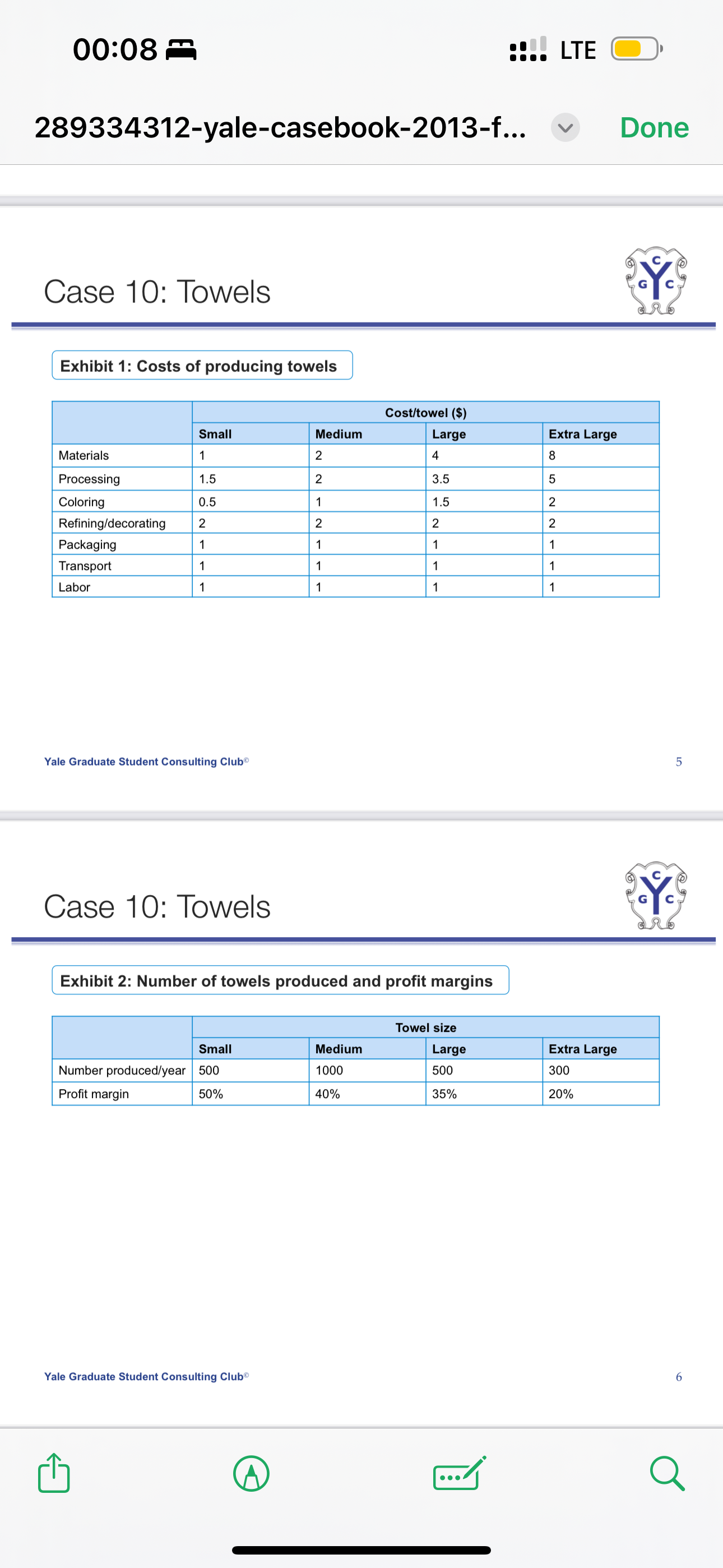
So in the last question they’re asking to calculate the net benefit of taking out their least profitable product (XL towels at 20% profit margin and costs of 20USD). Said net benefit is calculated as 300 (quantity) * 20USD (cost per towel) = 6k cost savings minus profit loss of 1.5k at a 20% margin.

HOWEVER: in the overview of the cost items they’re all VARIABLE costs. So aren’t they accounting for variable costs twice? Like: yes these are cost savings if the product is cut. But adding the profit loss (which already accounted for the variable costs) to the cost savings counts variable costs double? 

It would be different if additional overhead hence fixed costs could be cut, eg FC reduction by 400USD, then total net gain could be 400usd - profit loss of 1.5K. In this case would be a net loss actually and not advised


Or am I mixing something up?

2
< 100
0
Be the first to answer!
Nobody has responded to this question yet.
Top answer
Profile picture of Margot
Margot
Coach
8 hrs ago
10% discount for 1st session I Ex-BCG, Accenture & Deloitte Strategist | 6 years in consulting I Free Intro-Call

You’re not mixing things up. The confusion comes from mixing two different ways of doing the math. If those cost lines are all variable (and there are no fixed costs you can remove by dropping XL), then the clean way to think about “net benefit” is simply:

Net benefit of discontinuing XL = profit you give up on XL (because that profit would disappear) --> “Profit” already equals revenue minus variable costs. If you stop selling XL, you lose the positive contribution it was generating.

What goes wrong in the calculation your peer used?
They did: cost savings (variable costs avoided) minus profit loss.
But profit loss already includes those variable costs (profit = price − variable cost). So yes, that approach double-counts variable costs unless you also subtract the lost revenue. Here’s the correct arithmetic with your numbers:

1. Compute price and profit per XL towel

  • XL variable cost = $20
  • Profit margin = 20% (usually meaning profit as % of price)
  • Cost = 80% of price; Price = 20 / 0.8 = $25 --> Profit per towel = 25 − 20 = $5

2. Annual profit from XL
300 towels × $5 = $1,500 profit

3. Net benefit if you discontinue XL (no fixed costs removed)
You lose that $1,500 profit, so the “net benefit” is actually –$1,500 (a net loss), assuming nothing else changes. You can also show it the longer way (to prove there’s no double counting):

  • Variable cost saved: 300 × 20 = $6,000
  • Revenue lost: 300 × 25 = $7,500
  • Net change: 6,000 − 7,500 = –$1,500
  • If discontinuing XL also allows you to cut avoidable fixed costs (or capacity can be redeployed to higher margin products), then:

Net benefit = fixed costs saved + profit from best alternative use of capacity − lost XL profit

Conclusion: if you could cut $400 of fixed cost, net would be $400 − $1,500 = –$1,100 (still not worth it).

Profile picture of Janin
7 hrs ago
Thank you very much, that’s what I thought! :)
Profile picture of Kevin
Kevin
Coach
edited on Jan 09, 2026
Ex-Bain (London) | Private Equity & M&A | 12+ Yrs Experience | The Reflex Method | Free Intro Call

This is an excellent catch and exactly the kind of critical thinking that separates a good candidate from a great one. You are spot-on regarding the accounting logic; the case structure, as you’ve summarized it, appears to double-count variable costs.

If all the cost items listed ($20 per towel) are strictly Variable Costs, then discontinuing the product means you lose the Revenue but save the VCs. The net loss to the firm is the lost Contribution Margin (CM) (Revenue - VC). If the towel line still contributes anything positive toward covering fixed overhead (i.e., CM > 0), cutting it makes the company poorer, unless capacity can be reallocated to a higher-margin activity.

The only way the solution's logic holds is if the $6k "Cost Savings" did not refer to the variable costs but instead referred entirely to Avoidable Fixed Costs —for example, specific machinery depreciation or a dedicated supervisor salary that can truly be eliminated when the towel line shuts down.

The correct economic calculation for evaluating the strategic move is: Net Benefit = (Avoidable Fixed Costs Saved) - (Contribution Margin Lost). If that figure is positive, you cut the line. If the case simply saves VCs and loses CM, the decision is flawed.

It’s common for older practice cases to contain these logical errors because they try to simplify the accounting structure. Your job is not just to crunch the numbers they give you, but to challenge the inputs against fundamental economic principles. You identified the mistake perfectly.

All the best!

Profile picture of Janin
3 hrs ago
Thank you for the clarification Kevin! :)