










How many gas stations are there in Paris? Suppose a friend of yours wants to open a gas station in Paris. What aspects should he consider?
Case Prompt:
Sample Structure
Suggested case structure:
I. Strategies
How could you estimate the number of gas stations in Paris?
Information that can be shared if inquired:
Supply:
This is the more direct method. We can estimate the number of gas stations in Paris by estimating the number of gas stations in a big city.
If we assume that there is an average of one gas station per block in Paris (we assume that a block has an area of 1 km²), we can use Paris’ total surface area to estimate the number of gas stations in Paris.
Demand:
This strategy requires us to estimate the demand for gas in Paris. The demand should be proportional to the number of vehicles in the city. The number of vehicles in the city should be proportional to the number of inhabitants in the city.
Here, the interviewee should come up with two possible methods to estimate the number of gas stations in Paris.
Suggested methods:
- Estimate from the supply standpoint
- Estimate from the demand standpoint
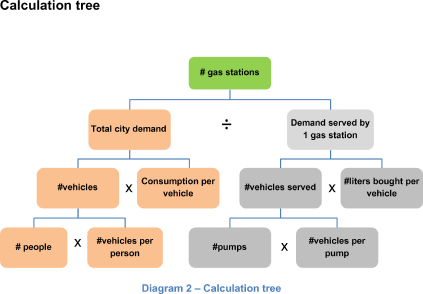
After calculating the total demand for gas in Paris, we need to estimate the demand that each gas station can serve. By dividing total demand for gas by the demand that each gas station can serve, we can estimate the number of gas stations in Paris.
II. Selection
Which approach is best to calculate the number of gas stations in Paris?
The first approach is very inaccurate because the population density of a block can vary significantly. This could cause the number of gas stations per block to vary.
The second strategy better reflects reality (gas stations are built as demand increases). Thus, we will use the second strategy to estimate the number of gas stations.
III. Calculation
How many gas stations are there in Paris?
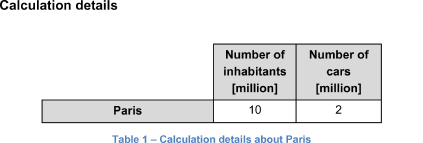
Share Table 1 (short overview) and Diagram 2 with the calculation tree if inquired by the interviewee.
Every time related variable (e.g. demand, consumption, # vehicles served etc.) is based on days.
First, we will calculate the total daily demand for gas in Paris (left side of the tree). There are about 10 million people living in Paris.
Since people below the age of 18 do not own cars and a lot of people use public transportation in Paris, we can estimate that there is 1 car for every 5 people.
There are also commercial vehicles such as trucks and company cars. (For simplicity’s sake, these are not shown in Diagram 2.) Let’s say that there are 4 times more private vehicles than commercial vehicles.
In total, there are 2.5 million vehicles.
- 20% (0.5m/2.5m) of the total vehicles are commercial vehicles.
- 80% (2m/2.5m) of the total vehicles are private vehicles.
To estimate the consumption per vehicle, we assume that cars have tanks of 50 liters. The tanks must be replenished every 10 days. Thus, each vehicle consumes 5 liters of gas every day.
Since commercial vehicles are on the road more frequently, they consume up to 5 times more gas than private vehicles.
We can calculate a weighted average of daily gas consumption per vehicle.
Thus, the demand for gas in Paris every day is 22.5 m liters.
Now, we can estimate the right side of the tree.
Let us assume that an average gas station has about 5 pumps. Each pump serves about 12 cars per hour during peak hours and about 5 cars per hour during off-peak hours.
If we assume that a gas station is open for 10 hours per day, 4 of which are peak hours, each pump serves 78 vehicles every day (4 * 12 + 6 * 5).
Thus, each gas station serves 390 vehicles every day.
For simplicity’s sake, we will round 390 to 400!
Assume that every time a vehicle visits a gas station, normal vehicles buy about 50 liters while commercial vehicles (some of them are trucks) buy about 100 liters.
This gives us an average of 60 liters bought per vehicle.
Every day, each gas station supplies 24,000 liters.
This gives us about 938 gas stations in Paris.
IV. Part 2
Suppose your friend wants to open a gas station in Paris. What aspects should he consider?
A good response to this question will consider both the attractiveness of the general industry and the proposed location of the gas station (Paris):
- What are a gas station’s typical profit margins?
Hypothesis: Profit margins are generally low due to fierce competition among gas stations.
- Why is competition among gas stations so fierce?
Hypothesis: Gas is a commodity. In big cities such as Paris, it is also a common good.
- What is the bargaining power of suppliers?
Hypothesis: Since the suppliers are massive multinational oil companies, their bargaining power is high.
- What is the bargaining power of customers?
Hypothesis: Low because they cannot bargain down the price of gas. However, they can easily drive to a different gas station.
- Are there substitutes in sight?
Hypothesis: Minor ones such as electricity for electric cars. However, given the current oil industry, this is a minor problem.
Key insights
This is a difficult industry to enter.
Your friend should only go ahead with this idea if there are other favorable conditions such as:
- A location with big market growth
- A location with little local competition
- Other sources of income (e.g.: a small market at the gas station)
Further Questions
What other sources of income could you think of for a gas station in a big city?
Possible answer:
Bundle products like:
- Car-wash discount for clients who buy more than 50 liters
- A small convenience shop which sells food and pharmaceutical items.
- Maintenance services for cars such as oil changes and brake maintenance.
If the interviewee solves the case very quickly, you can come up with more challenging questions to ask them.
Without your consent we cannot embed YouTube videos. Click the button below and accept the marketing cookies to allow YouTube videos to be embedded.
By allowing this service, you consent, in accordance with article 49 paragraph 1 sentence 1 lit. a GDPR, to your data being processed in the USA. The USA is not considered to have adequate data protection legislation. Your data could be accessed by law enforcement without prior public trial in court. You can change your settings regarding consent to external services at any time in our Cookie and Privacy Settings.
Gas station
i