



Expert case by
Moritz

Zero Carbon Mine (McKinsey 1st & 2nd round)

Difficulty: Advanced
Interviewer-led
< 100 Ratings
Times solved: 4.6k

Case Prompt:

Client goal

Our client is an international mining company Global Mining Corp (GMC) that focuses on copper mining and is interested in the possibility of producing and selling “green copper”, which is the same product as normal copper but with a certified zero carbon footprint for its entire life cycle until sale. The client engaged your team to help determine the prospects for achieving net zero for their Chilean and Australian copper mines in the next 10 years and decide whether they should pursue this path.

Description of situation

The client operates open pit copper mines mostly in remote areas of Chile and Australia. In most cases, the copper ore is blasted with explosives and turned into rubble, which is then collected by heavy bulldozers in big piles, loaded by power shovels onto haul trucks, which transport the material over several kilometers to the processing site. Mobile equipment is diesel operated and very heavy, up to 400 tons for a fully loaded haul truck. During processing, a series of mechanical operations take place to break down the rubble further before chemical processes like acidic leaching are used to produce the final product: copper cathodes. This material is then transported by trucks and rail to the nearest port where it can be shipped to its final destination, depending on the customer.

Overview of All Exhibits
Practice makes the difference
Practicing alone helps – with a partner it’s even better. Solve this case in a realistic mock interview.
Schedule on Meeting Board

Question 1

What do you think would be some of the factors affecting whether GMC should pursue the production and sale of green copper within the next 10 years?

Show additional information Hide additional information
Show solution Hide solution

Question 2

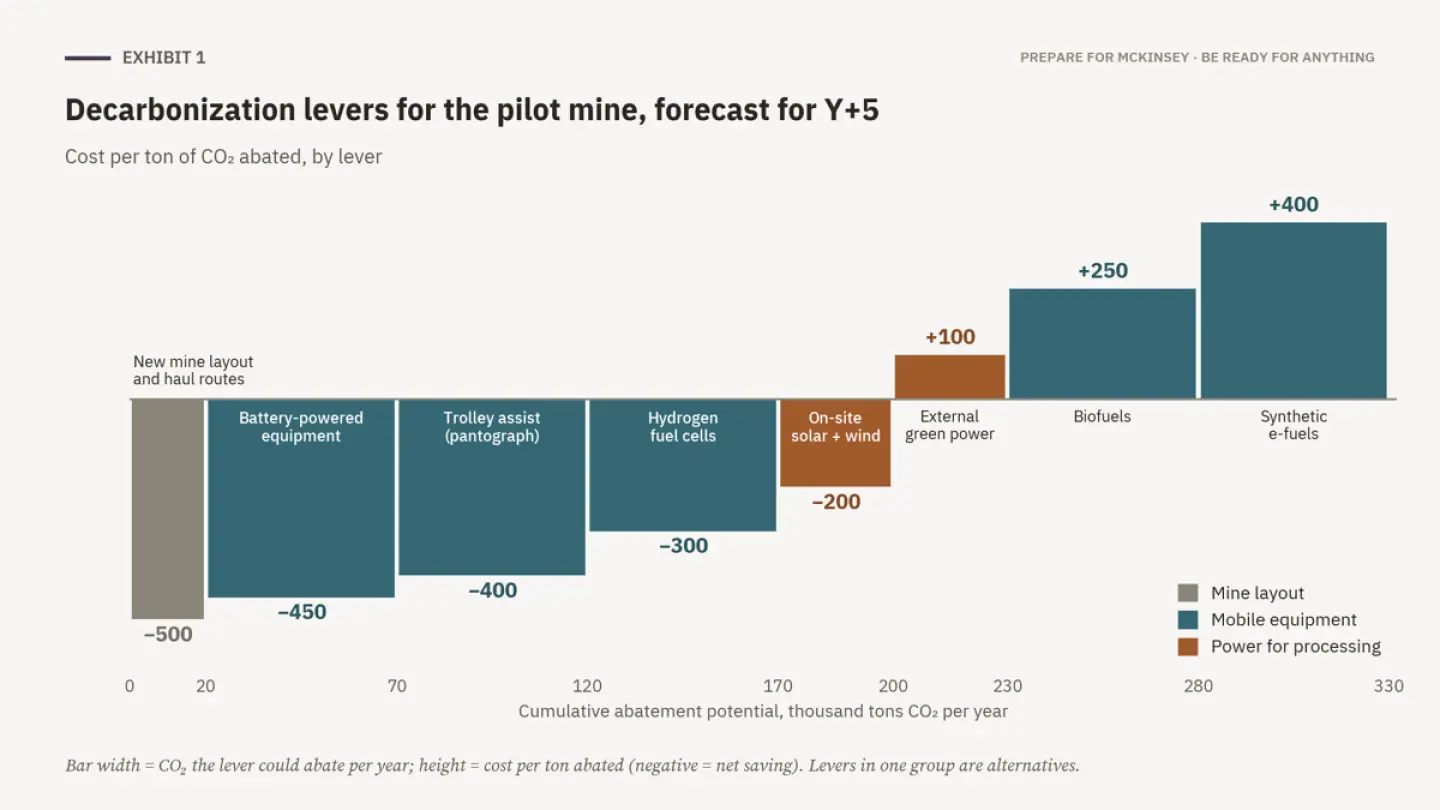
The team set out to investigate different technology levers for CO2 abatement that could be implemented to achieve zero carbon for a pilot mine in Chile, which produces emissions of 100,000 tons of CO2 per annum, excluding transport away from the mine. Exhibit 1 shows these levers on an abatement curve that compares total abated tons of CO2 per lever and the corresponding cost per abated ton of CO2. What can you make of this analysis?

Show additional information Hide additional information
Show solution Hide solution

Question 3

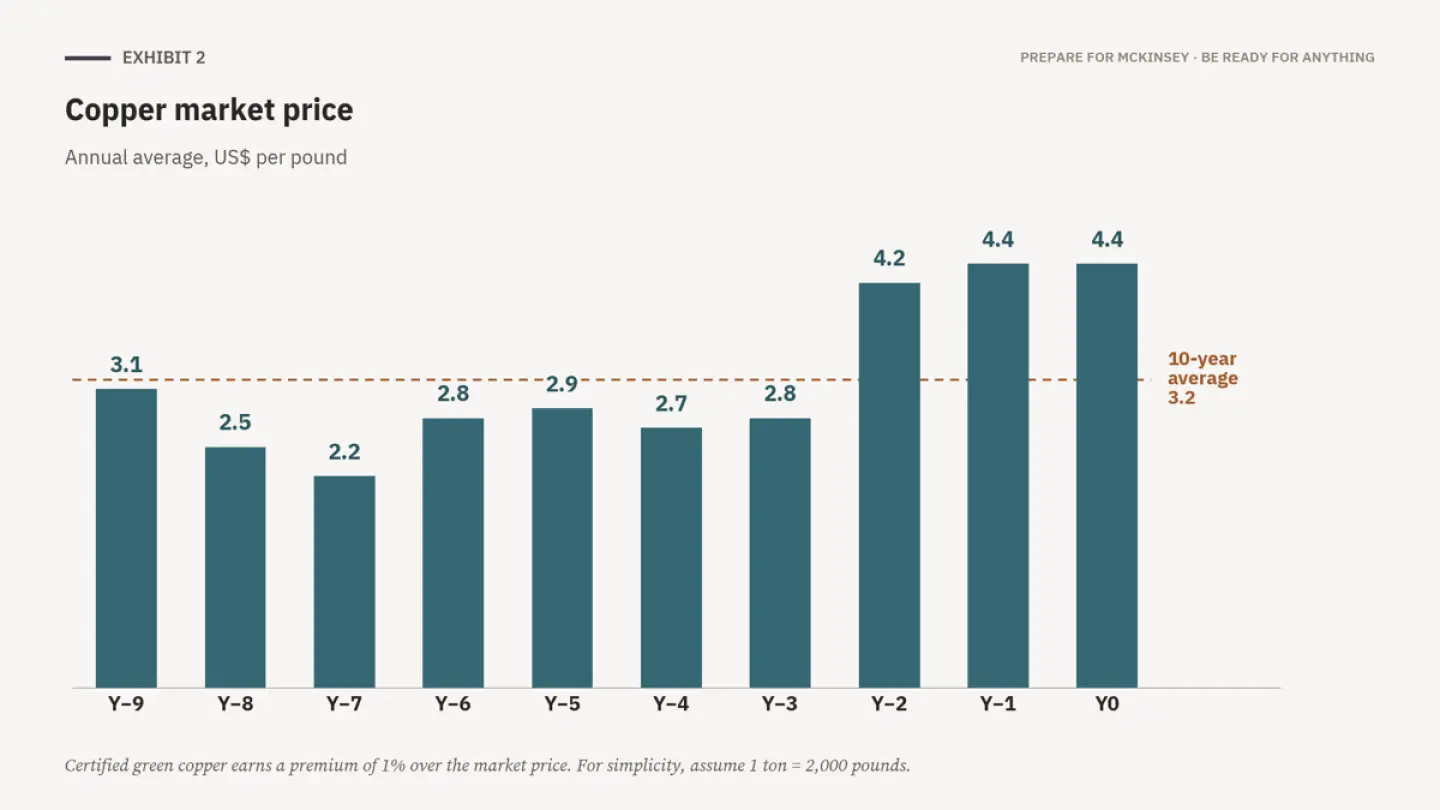
The team acknowledges that nowadays, technology availability and cost for enabling green copper are less favorable compared to 2030. Considering the information in Exhibit 2, what is the maximum average cost per abated ton CO2 for the pilot mine in Chile today if the goal is to break even with a yearly copper production of 1.0 million tons?

Show additional information Hide additional information
Show solution Hide solution

Question 4

What are some of the non-financial aspects that you can think of considering a potential pathway to green copper and zero carbon mining for CMG?

Show additional information Hide additional information
Show solution Hide solution
Practice This Case With Peers Who Are Currently Looking for Interview Partners.
Do you have questions on this case?
Ask our community and receive answers and tips directly from our experts.
Ask a question Ask a question
Related Case Interview Basics Articles
McKinsey Growth Pyramid
Useful Business Analysis Tools
The McKinsey Growth Pyramid is a strategic tool that helps businesses systematically explore growth opportunities. As the name suggests, it was developed in the 1980s by the renowned management consulting firm McKinsey & Company. It prioritizes different approaches to expansion and offers a structured roadmap for companies to increase revenue, expand their market presence, and drive long-term sustainability. This framework is widely used in consulting, including in case interviews, as it provides a clear methodology to assess how companies can scale efficiently.
To the article
7S-Framework of McKinsey
Frameworks
If you're aiming for a career in consulting, learning about key frameworks is essential. One of the most popular and effective tools is the McKinsey 7S Framework. Created by McKinsey & Company, this framework helps you understand and evaluate how different parts of an organization work together to improve overall performance.In this post, we’ll explain the seven elements of the McKinsey 7S Framework and how you can use it in case interviews. Whether you're preparing for consulting roles or just want to boost your business knowledge, this framework is a valuable tool to have in your skillset!

To the article
The Influence Model
Useful Business Analysis Tools
The McKinsey Influence Model was developed in the early 2000s and is the result of extensive research and practical experience by consultants. Originally designed to help companies tackle challenges, the model has now established itself as an indispensable framework in the field of consulting.
To the article
Interviewer- vs. Candidate-Led Cases
Basics of Case Interviews
Every case interview has a certain structure. An important factor on how your case interview is going to proceed is if the interview is interviewer-led or candidate-led.We’d like to explain the two interview formats – candidate-led cases and interviewer-led cases – highlight their differences, and provide you with tips on how to excel in each of them.
To the article
Practice makes the difference
Practicing alone helps – with a partner it’s even better. Solve this case in a realistic mock interview.
Add invitation
Do you have questions on this case?
Ask our community and receive answers and tips directly from our experts.
Ask a question Ask a question