Corporate strategy interviews combine consulting-style case questions with behavioural and industry-specific discussions, testing both analytical and business maturity.
Compared to consulting interviews, they are less structured, more conversational, and require stronger industry understanding and practical, company-specific thinking.
Success depends on strong case fundamentals, well-prepared fit stories, and the ability to apply structured thinking flexibly in less predictable interview formats.
What Is the Corporate Strategy Interview?
The corporate strategy interview sits in an interesting middle ground. It is not quite the same as a management consulting interview, but it is also usually not a pure functional interview in the way that finance, operations, or marketing interviews might be.
In most cases, the corporate strategy interview is designed to test whether you can think like an internal strategist inside a company – can you not only think like a consultant but can you also operate effectively in a real corporate environment where stakeholders, constraints, and politics all matter.
This usually means the interview is a mixture of components that may be different from the traditional consultingcase interview, and in reality the exact style and format of corporate strategy interviews can vary significantly from company to company
That is why many candidates find the corporate strategy interview familiar, but slightly harder to pin down. It often borrows heavily from consulting-style interviewing, but tends to be less standardized and more fluid.
This guide is mainly for three groups of candidates.
1. Undergraduates / MBAs applying to corporate strategy roles
If you are applying straight from university or business school, corporate strategy can be a very attractive role. It gives you exposure to senior business issues, broad visibility across the company, and a chance to build strong problem-solving and communication skills early in your career.
That said, many candidates underestimate how demanding these interviews can be, especially if they treat the interview as a typical corporate interview. Because strategy teams often work on high-priority topics for senior leadership, the bar is usually quite high. Even at the entry level, interviewers are not just looking for ‘brains’ by itself.
2. Consultants looking to exitconsulting into corporate strategy
This is the most common candidate pool for corporate strategy hiring. Many corporate strategy teams are filled with ex-consultants, particularly from MBB and other strategy firms, because consulting develops many of the core skills the role often requires.
If you are coming from consulting, that is clearly an advantage. You will likely already be comfortable with structured problem solving, executive communication, and business cases. However, it is important not to assume that this is simply a consulting interview in a different wrapper.
In my experience supporting consultants looking to transition, many make the mistake of over-indexing on polished case mechanics and under-indexing on the practicality and maturity of the answer. The skill overlap is real, but the expectations in the interview are different.
This group includes people coming from functions such as finance, operations, product, commercial, business development, or general management who want to move into a more strategic role and grow their corporate toolkit.
If you fall into this category, the challenge is often slightly different. You may already know the business well and have strong functional credibility, but you need to show that you can step beyond from your own area and think more strategically and demonstrate skills that you may not have been exposed to in the same level of depth and rigor that your interviewer is expecting.
Land your top job with PrepLounge!
Sign up now for free and get access to our Q&A, top coaches, preparation tools and much more.
At a high level, the corporate strategy function helps leadership answer the company’s biggest questions and how to strategically unlock and accelerate value within the company, e.g. where to grow, where to invest, how to respond to market shifts, how to improve internal operations etc.
In many companies, the role is not purely “strategy”. It is often a mix of strategy and implementation / transformation, which means the team may help define the answer and also help drive it forward through project management, cross-functional coordination, and execution tracking.
The exact balance differs from company to company. Some teams are more focused on classic strategy work such as growth strategy, market entry, or portfolio decisions. Others are more closely linked to transformation and execution.
In some cases, the mandate is even broader and can extend into areas closer to corporate development or business development, such as partnerships, acquisitions, investments, or strategic deals.
What skills are required?
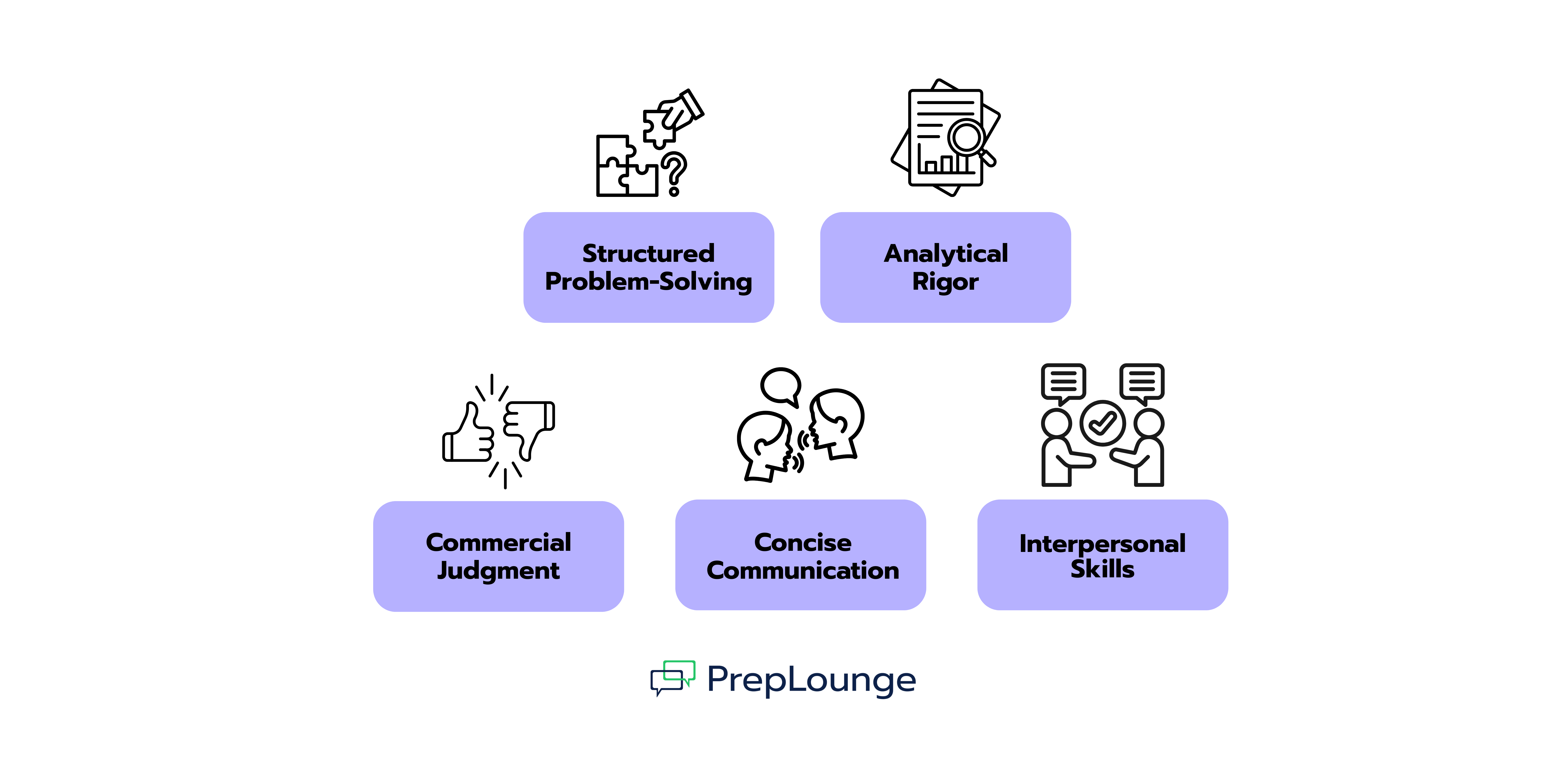
If you look at the scope of what the corporate strategy function does, the required skill set becomes quite clear.
Structured problem-solving
Corporate strategy teams deal with ambiguous business questions all the time, so you need to be able to solve problems in a structured manner – using the same approach that consultants at MBB firms do.
Analytical rigor
Be able to define and conduct rigorous analysis that gets to the best answer.
Being comfortable with data and quantitative reasoning.
Commercial judgment
It is not enough to just know how to run a structured problem solving and conduct analysis – it is critical that you are able to synthesize the insights and generate relevant insights.
Concise communication
Strategy teams often work with senior stakeholders, so you need to explain complex issues simply, communicate recommendations crisply, and speak in a way that creates confidence.
Interpersonal skills
Just like consulting, corporate strategy is rarely done in isolation. You are often navigating different functions, competing priorities, and imperfect information. Being right is not enough; you also need to be effective.
In other words, the required skills are, in many ways, essentially the same skills that matter in consulting. That should not be surprising. The underlying work is similar: ambiguous business questions, structured & rigorous problem solving, and high expectations on executive-level problem solving communication.
This is also why many of your interviewers are often ex-MBB or ex-consultants themselves. They have been hired precisely because their experience in consulting had given them the toolkit needed. They know what good structured thinking looks like. They know how strong candidates communicate. And having spent some years in the role, they are also usually very attuned to whether you have the potential to adapt the core consulting-style toolkit in a way that translates well into corporate strategy environment.
The Format of the Interview
For most corporate strategy roles, you should expect a mixture of behavioural questions, case / problem-solving questions, and sometimes industry expertise questions.
The behavioural portion is there to assess things like why you want the role, why you want to join that company, how you work with others, how you handle ambiguity or conflict, and examples of leadership, influence, and problem solving from your past.
This part matters a lot more than some candidates think. Particularly for internal strategy roles, hiring teams care not just about whether you are smart, but whether you are really the right fit for the company.
The case or problem-solving portion is where they assess how you think. This may involve a classic business problem such as market entry, profitability, growth strategy, operational improvement etc. In some instances it may be tailored more directly to the company or industry. In the corporate strategy interviews I have sat for myself, my interviewers often used an actual project or initiative they were currently working on as the case problem.
There is also a third type that shows up quite often: industry expertise questions. These are questions that test your understanding of the industry, market dynamics, business model, competitive landscape, and topic-specific issues relevant to the company. This is in-line with how many job descriptions will have a requirement such as or “experience in [industry] required” or “experience in [industry] preferred”.
What’s similar to the Consulting Case Interview?
There is a lot of overlap with consulting interviews, which is why consulting preparation is still very relevant. All of the points mentioned above on structured thinking, analytical rigor, communication matter.
In short, if you have done good consulting case interview preparation, that foundation is highly useful. A lot of the same muscles are being tested.
What’s different to the Consulting Case Interview?
There are a few important differences, and it helps to try and break the differences down rather than as one vague sense that the interview feels “less casey.”
1. The interview flow is often less structured
In a normal consulting case interview, there is often a recognizable cadence. You get the prompt, clarify the objective, take a moment to structure, present a framework, and then work through the case in a relatively deliberate sequence.
Corporate strategy interviews do not always follow that pattern.
You may not be given time to pause and build a formal framework. The interviewer may want you to start discussing the issue immediately. They may also jump around between topics such as customers, competition, risks, execution, and stakeholder implications without giving the conversation a neat case-interview flow.
The structured interview format is much less guaranteed, but structured thinking is still expected, so the question for you as a candidate is how do you show structured thinking despite not having a predictable format?
2. Industry expertise can matter much more
This is one of the clearest differences.
In consulting interviews, the bar is usually more about whether you have a strong generalist toolkit. Can you structure unfamiliar problems, think logically, interpret data, and communicate clearly?
In corporate strategy interviews, you may also be tested on specific industry knowledge. That means understanding the sector, business model, value chain, competitors, major trends, regulatory issues, and topic-specific themes that matter to the company.
This is a different kind of test. Here, the interviewer is not only asking, “Can this person solve business problems?” They are also asking, “Does this person actually understand our industry and can they speak credibly about it?”
That is why a strong consulting-style candidate can still underperform if they show up with only broad business skills and not enough company or sector knowledge.
In my experience, many candidates (especially looking to exit from consulting) often do not have the direct, deep expertise on the industry they are applying to. Therefore, the interesting question for you as a candidate is how do you either ramp up quickly or demonstrate that you are not a weak candidate, despite not having done many projects in that topic?
3. The balance between fit and case can be very different
In many consulting interviews, the case takes up the majority of the interview time and fit is relatively shorter.
In corporate strategy interviews, the split can be much more even. In some interviews, the behavioural portion may take up close to half the discussion. That means your motivation, communication style, stakeholder maturity, and examples from past experience may matter just as much as your problem-solving performance.
Candidates sometimes prepare as if the case will dominate, and then get caught off guard when the interview spends much more time on fit or other topics than expected.
The interesting question for you as a candidate then is to figure out and pre-empt some difficult or challenging questions that likely may be asked to you, based on your specific profile.
4. The discussion is often more practical and company-specific
Consulting cases can sometimes feel clean and self-contained and theoretical. Corporate strategy interviews are often closer to how real internal discussions happen.
The interviewer may expect you to think not just about the analytical answer, but also about what is realistic for this company, what constraints the business may face etc.
This practicality needs to be imbued into your responses, so the bar is not just “good analysis.” It is “good analysis that makes sense inside a real company.”
5. You may need to generate insights with less support
In consulting interviews, you are often given exhibits, charts, tables, or data to react to.
In corporate strategy interviews, you may get much less scaffolding. Sometimes there are no charts, no graphs, and no exhibits at all. Instead, you are expected to generate the relevant lines of inquiry yourself, connect business ideas on the fly, and still arrive at sensible insights.
That can feel more conversational, but it can also be more demanding because the signposting is weaker.
How to Best Prepare for the Corporate Strategy Interview
The good news is that preparation for corporate strategy interviews is very manageable if you focus on the right areas.
1. Brush up on case interview fundamentals
If you are a consultant, you will understand that doing the job is quite different from the case interview. You will need time to brush up on the mindset, approach and most importantly on fundamentals. If you do not have a consulting background, focusing on case interview fundamentals becomes even more crucial. You should be comfortable with:
structuring ambiguous business problems
conducting rigorous analysis
getting to commercially strong insights
being able to communicate in a concise and structured way
If your case fundamentals are weak, you will not pass the corporate strategy interview, this is a tablestake.
Do not neglect the behavioural side. You should have strong, polished stories for the typical themes asked in the consulting interview, and go deeper on your CV and pre-empt some potential situational questions that could also be asked.
Most importantly – and this is something that is the trickiest to do – you need to ensure your overall ‘story’ is compelling, especially if you did not do many projects related to the industry you are applying for.
3. Research the company and industry
This matters a lot. Because corporate strategy is an internal role, interviewers will expect you to have a decent understanding of both the business and the industry it operates in. Do not show up to the interview without knowing the basics of the company.
4. Practice
This is arguably the most important part.
Ideally, you should practice with someone experienced who understands both consulting-style interviews and the more unstructured, free-flowing style that often comes up in corporate strategy interviews.
That is because the challenge is not just solving the problem. The challenge is being able to stay composed and sharp when the discussion does not follow a neat script, and when the interviewer expects more than a theoretical answer, but something more mature and nuanced.
A good practice partner or coach can simulate this well. They can push you off the usual consulting cadence, ask more open-ended and less signposted questions, test your maturity in a realistic way.
The corporate strategy interview is best thought of as a close cousin of the consulting interview, not a completely different species.
A lot of the same core skills matter, but there are also important differences.
TLDR: my general advice would be simple: treat it like a consulting-style interview, but with more emphasis on practicality, company context, and industry understanding.
Ex-BCG Principal | 8+ years consulting experience in SEA | BCG top interviewer & top performer
Benjamin has >8 years of consulting experience, starting off at Kearney SEA and he joined BCG as an experienced hire, where left as a Principal. At BCG, Benjamin was fast promoted twice (Consultant to PL; PL to Principal) and was also selected to be a CEO Ambassador (internal secondment). Benjamin has a wealth of case experience across multiple functions (Strategy, Operations, Transformation, Due diligence) and industries (PE, TMT, Public Sector, Consumer, Tech). While focused on SEA, Benjamin has also done cases in the Middle East, North Asia as well as South Asia.
At BCG, Benjamin had ~5 years of experience as an interviewer. Having come from a non-traditional background himself, Benjamin can offer practical tips for experienced hires and non-traditional candidates.
Benjamin graduated with a B.A. (First Class Honours) in History from the National University of Singapore.
Common Questions about Corporate Strategy Interviews
A corporate strategy interview tests whether you can think like an internal strategist and solve real business problems in a structured, practical way within a company context. The focus is on applying analytical thinking to real organisational challenges.
It is less structured and more conversational than consulting interviews, with a stronger focus on industry knowledge and company-specific constraints. The discussion often feels more fluid and closer to real internal decision-making.
Key skills include structured problem-solving, analytical thinking, commercial judgment, communication, and interpersonal ability. Interviewers also assess how well you handle ambiguity and stakeholder complexity.
You will face a mix of behavioural, case-based, and sometimes industry-specific questions. These are designed to test both your thinking process and your understanding of the business context.
Focus on mastering case fundamentals, preparing strong fit stories, and building solid company and industry knowledge. In addition, practice realistic, less-structured interview scenarios.
Ex-BCG Principal | 8+ years consulting experience in SEA | BCG top interviewer & top performer
Benjamin has >8 years of consulting experience, starting off at Kearney SEA and he joined BCG as an experienced hire, where left as a Principal. At BCG, Benjamin was fast promoted twice (Consultant to PL; PL to Principal) and was also selected to be a CEO Ambassador (internal secondment). Benjamin has a wealth of case experience across multiple functions (Strategy, Operations, Transformation, Due diligence) and industries (PE, TMT, Public Sector, Consumer, Tech). While focused on SEA, Benjamin has also done cases in the Middle East, North Asia as well as South Asia.
At BCG, Benjamin had ~5 years of experience as an interviewer. Having come from a non-traditional background himself, Benjamin can offer practical tips for experienced hires and non-traditional candidates.
Benjamin graduated with a B.A. (First Class Honours) in History from the National University of Singapore.