Finding the right balance between breadth and depth is essential. Exploring different areas builds a strong foundation, while developing expertise creates long-term value.
Specialization can accelerate professional growth. Building expertise in a specific area strengthens credibility, networks, and future career opportunities.
A successful specialization combines personal interests with market relevance. The strongest career paths emerge when individual strengths align with valuable expertise.
One of the most common questions I receive from junior consultants is whether to specialize early or remain a generalist as long as possible. The standard advice favors the generalist: preserve your options, experience as much as possible, decide later. I understand the logic, but after more than a decade at BCG I am a firm believer in the opposite view. I do not advocate specialization from day one, but far sooner than the conventional advice allows. Here's why.
Two types are frequently confused. One is sectordepth: you become the specialist in a given “vertical” (e.g. consumer goods, financial institutions, industrial goods). The other is functional depth: you develop your expertise in a given “horizontal” (e.g. pricing, operations, marketing and sales). You can specialize on one axis, on both, or on neither. Most of what follows applies to either, but it helps to know which you are choosing, because the trade-offs differ. Sector depth exposes you to an industry cycle. Functional depth transfers across industries but confines you to a single type of problem.
Land your top job in consulting!
Join the world's leading case interview community today and get everything you need to prepare for your upcoming case interviews!
You build real credibility, faster. Depth compounds. Your second case in a sector is sharper than your first, your fifth sharper than your second. When a retail client asks why margins are declining, the specialist already knows the usual causes (e.g., promotional intensity, private label, channel shift) and proceeds directly to the real question. In a room of generalists, the one who knows the industry has a clear advantage. That credibility is difficult to fabricate and slow to build, so beginning early matters.
You build a pyramid that supports you. As you develop depth in a topic, the principals and managers in that practice come to know you and begin to invite you onto their cases. The partner who leads the firm's consumer goods work knows you by name. That demand, sponsors above you and a team forming below, sustains you through promotions. Generalists reconstruct that base each time they move. Specialists compound it.
You become commercially useful sooner. This is the one juniors underestimate. Consulting companies promote those who help win and sell work. With a genuine perspective on a sector or topic, you can contribute to the proposal, shape the argument, and sit in the client conversation with something to say, years before a generalist can. Commercial relevance is what makes Partner, and specialization is the fastest route to it.
The case against (and it is real)
You see less. Breadth builds a versatile problem solver. The best consultants transfer patterns across industries, and if you narrow too early you lose that exchange across fields. The person who has worked only on cost cases will default to a cost answer even when the problem concerns growth. Limited exposure leaves you with a narrower toolkit than your generalist peers.
You carry concentration risk. You are betting on a sector or a topic. When your area cools, transactions decline and budgets freeze, the generalist redirects to wherever the work is, while the narrow specialist must wait. And the longer you specialize, the more difficult it becomes to pivot.
You commit before you know yourself. Early on you do not yet know what you excel at or what you really enjoy. You might discover, two years later, that you prefer operations, having spent that time becoming a competent pricing analyst. The cost of a wrong bet only grows with time.
My view
Overall, I am firmly in favor of early specialization, with one caveat on timing. Do not specialize immediately. Allow yourself an initial period, your first year or two, to explore different industries and types of problem. Then choose a focus and commit. Those who remain generalists too long tend to stagnate: useful everywhere, essential nowhere. Those who develop depth build the credibility, the sponsorship, and the commercial relevance that genuinely advance a career.
The disadvantages are manageable if you choose well. Choose an area that is large and durable rather than a narrow niche, and you reduce most of the concentration risk. Maintain a general approach to problem-solving even as your domain narrows, i.e. specialize in the topic, not in the thinking, and your toolkit remains sharp.
That said, remaining broad is the correct choice in a few situations. If you honestly do not yet know your focus, imposing a choice is worse than exploring for another year. If you work in a smaller office where the work is whatever the market sends, breadth is not a choice, it is the job. And very early, before you possess any depth at all, variety builds the foundation from which you later specialize. The generalist phase is worth having. It simply should not become the entire career.
What it means for you
The right timing depends on where you stand.
If you are still applying and have little or no experience, you will almost certainly join as a generalist. No one asks you to choose a specialization at the door. What you can do now is notice which industries and which problems pull you, and, in your interviews, show genuine interest in an area rather than pretending to like everything equally. Informed enthusiasm reads as maturity, and it is remembered.
Once inside, treat the first year as orientation, not commitment. Sample widely, and when a sector or a topic begins to interest you, act on it: request staffing in that area, accept the repeat cases, build relationships with the partners who lead it, and form a genuine point of view by following its deals and its economics. Specialization is rarely assigned. You construct it, case by case, until the practice associates your name with the subject.
If you join as an experienced hire, thereverse applies. Your prior industry is the reason you were hired, so lead with it. Apply into the practice that matches your background, present yourself as a specialist from the first conversation, and treat that expertise as your platform inside the firm. Your orientation phase is short. You are not looking for a focus; you already have one. The task is to convert it into internal credibility quickly.
How to choose your focus
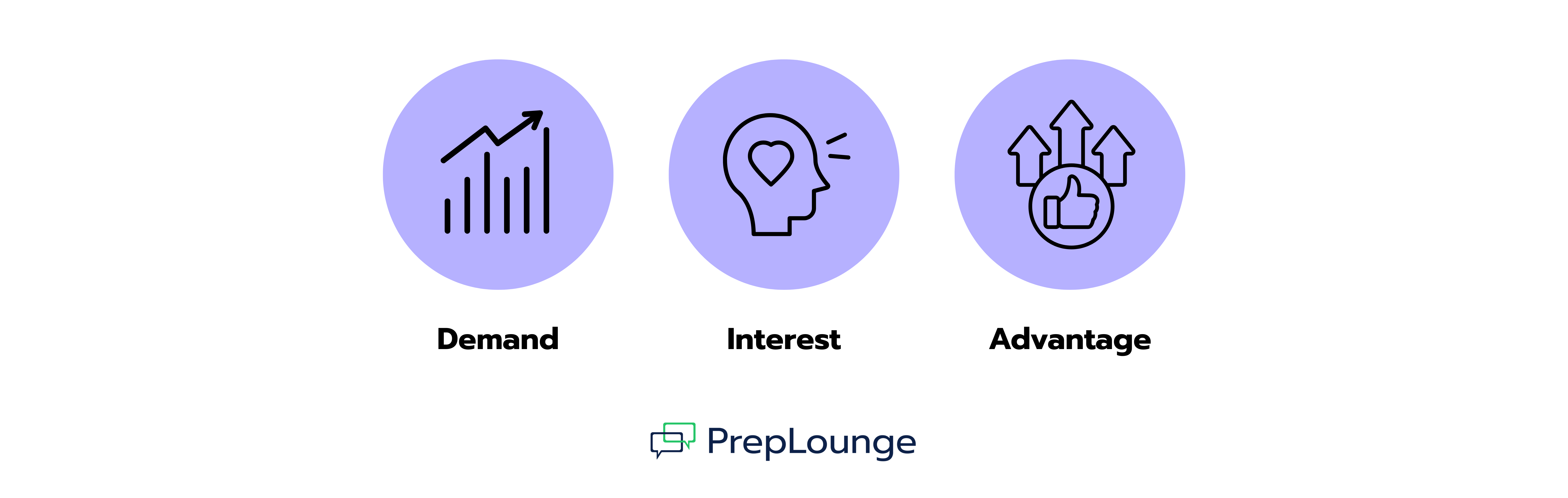
In my experience, you should consider three factors when choosing where to focus. First, demand: choose an area that is large and durable, not a passing trend. Second, interest: you will live here for years, so it must be something you would still want to read about on a Sunday. Third, advantage: incline toward where you already have one, a prior industry, a language, a network, a background others do not possess. Where the three overlap should be your focus.
Specialization and exit opportunities
This matters more than most juniors expect, since the majority will eventually leave consulting. A specialist exits with a clear identity: if you are known for consumer, the companies, the brands, and the funds that invest in the sector already understand what you bring, and you compete on fit. A generalist exits with a strong brand name but a less differentiated profile, and competes more on pedigree than on relevance.
There is one qualification. For an early exit, after two or three years, the name of the firm still carries most of the weight, and breadth costs you little. The more senior the exit, the more the market pays for depth. Specialization is not only an internal asset. It is the profile you take with you when you leave.
I have watched this play out across the people I have coached and mentored, and, by the way, this conviction also shaped my own career. Indeed, I started as a generalist at Oliver Wyman, tried a few industries, and discovered the consumer world. I liked it, and from there I made it a deliberate focus, which brought me to BCG, where I was hired from day one to do consumer, and I never left. Even as a junior it built real credibility: the practice knew me, I earned an MBA sponsorship, and I secured a transfer to another office, where I stayed in consumer all the way to Partner.
Ex-BCG Partner, Interviewer & Career Advisor | Fully tailored approach
Common Questions about Specialization in Consulting
No, early-career consultants should first gain exposure to different industries and problem types. After building a foundation, choosing a focus area can help accelerate professional growth.
Specialization helps consultants build deeper expertise, stronger credibility, and valuable internal and external networks. It can also increase their impact on client projects and career opportunities.
Yes, specializing too early can limit exposure to different perspectives and may lead to choosing an area that does not match personal interests. Maintaining broad problem-solving skills while developing expertise is important.
A good specialization combines personal interest, market demand, and individual strengths or experience. The best focus areas are those where consultants can create unique value over time.
Yes, specialists often leave consulting with a clearer professional profile and stronger industry positioning. However, broad consulting experience can also be valuable, especially in early career transitions.