

Back to overview

Question on Coaching sessions

Hi coaches, if a candidate comes to you at an early stage of preparation (e.g. has done ~10 cases, understands the basic case flow and some theory) and wants to sign up for 10 coaching sessions, how would you structure the overall prep plan and coaching sessions?

Assuming the candidate is not rushing for a specific application deadline, but instead wants to become genuinely well-prepared before applying and maximise their chances once applications are submitted, how would you approach the preparation journey?


9
8
400+
Be the first to answer!
Nobody has responded to this question yet.
Top answer
Profile picture of Virginia
edited on May 17, 2026
Expert Coach for Revolut | Problem Solving, Product Sense & Bar Raiser | Real-life Revolut experience | Ex-McKinsey

Good question. Here's how I'd think about it:

Sessions 1-2: Diagnostic. A live case or two where I'm mapping your real gaps: where exactly do you break down? Structure? Quant? Synthesis? It's not about scoring you, but knowing what to prioritize (and whether you actually need 10 sessions or can do just fine with less).

Sessions 3-6: Full cases, but each one chosen to stress a specific weakness. You still need the reps and pattern recognition that come from doing complete cases, but the case selection is deliberate.

Sessions 7-10: Full cases under realistic pressure, integrating everything. You want consistency by this point, not just occasional good performances.

Worth noting: 10 sessions focused on cases is solid, but fit/PEI is a whole separate prep track that deserves its own dedicated time. Don't let it become an afterthought!

And the work between sessions matters as much as the sessions themselves. Specific drills with clear goals, not just "go do 5 more cases on your own".

Profile picture of Tommaso
Tommaso
Coach
edited on May 17, 2026
Ex-McKinsey | MBA @ Berkeley Haas | Experienced Hire Specialist | 50% off on 1st meeting in July (DM me for promo code!)

Hey Anonymous,

First of all, I never tend to sell packages of 10 coaching sessions. If I do a great job, 5-6 sessions are usually enough to cover everything, provided they are paired with clear at-home exercises, curated self-study, and structured practice. I hate overselling — that's actually the first reason why I left consulting.

That said, here is how I would personally structure the prep:

1. Start with a diagnostic. 

One session, sometimes two if you want, to really understand where you stand. From there, I build a tailored path of 4-6 lessons depending on what the diagnostic reveals. The goal is not to "cover the casebook" (i.e., one case for each case type) but to holistically build your business sense. Business sense is essentially awareness — and once you have it, it lets you solve any case, regardless of the type.

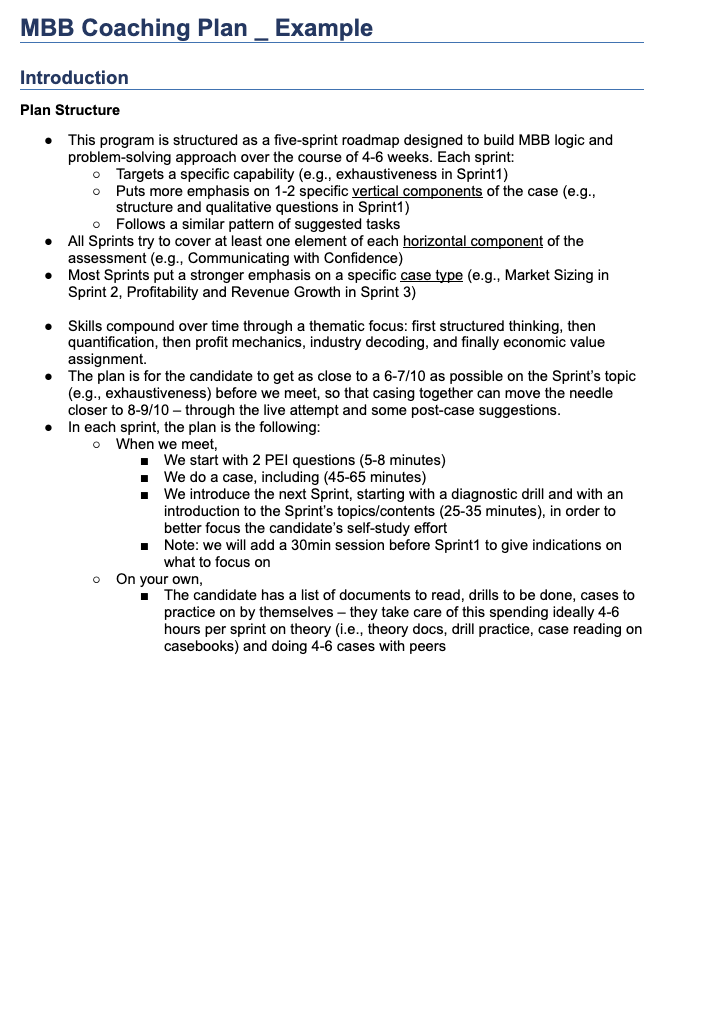
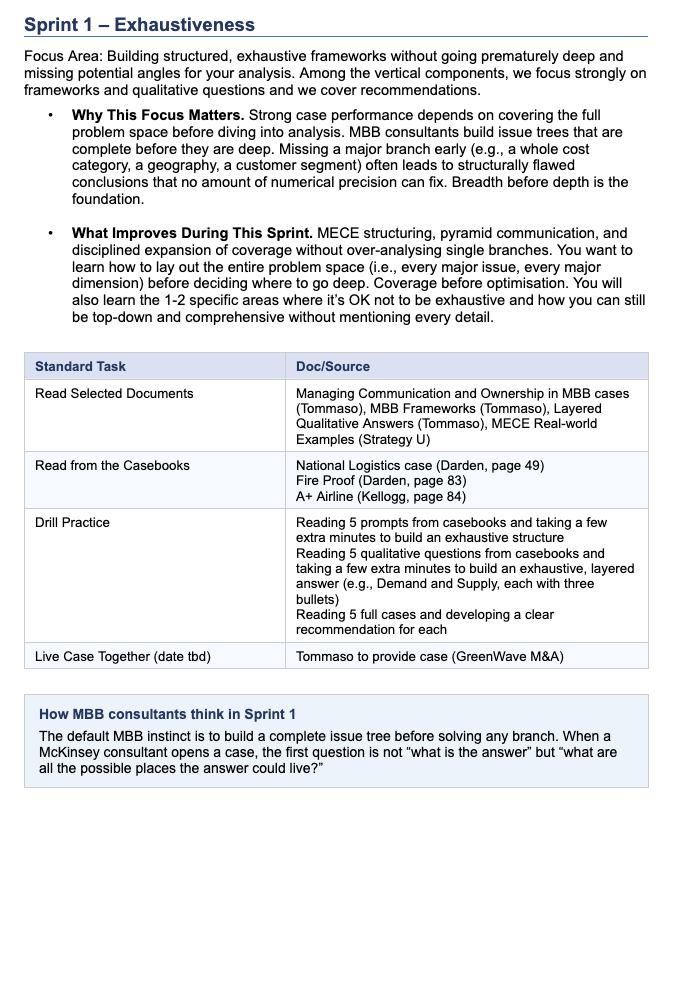
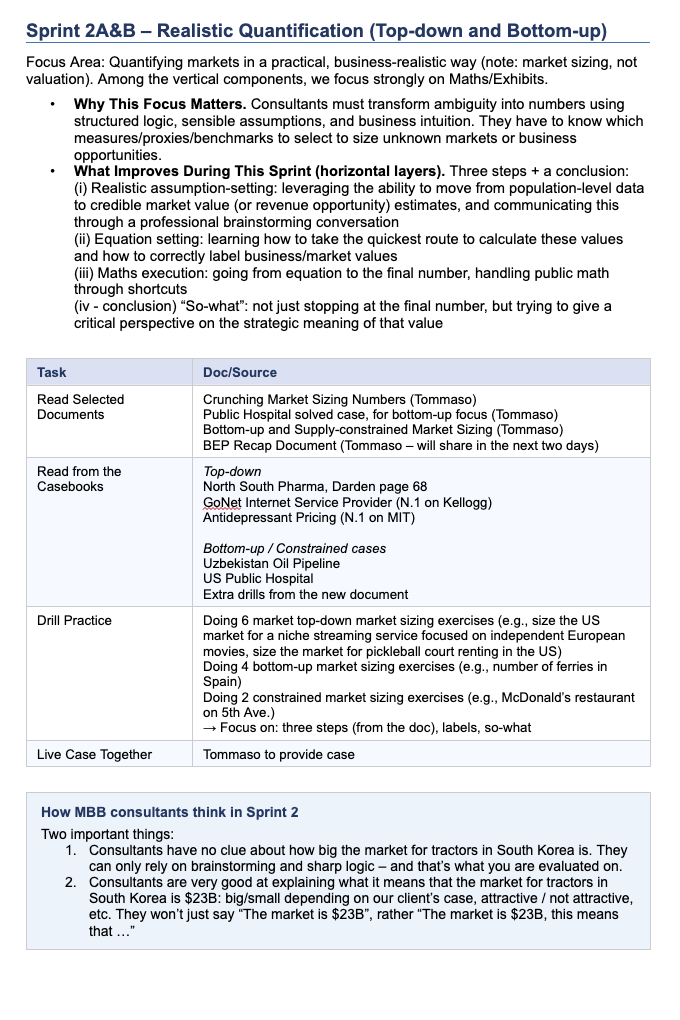
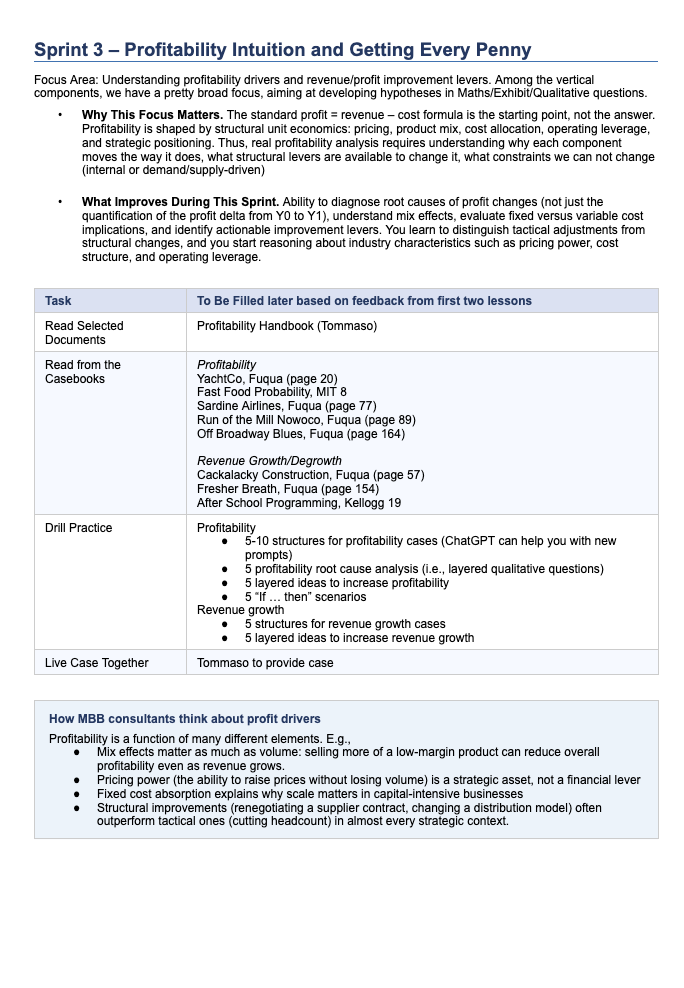
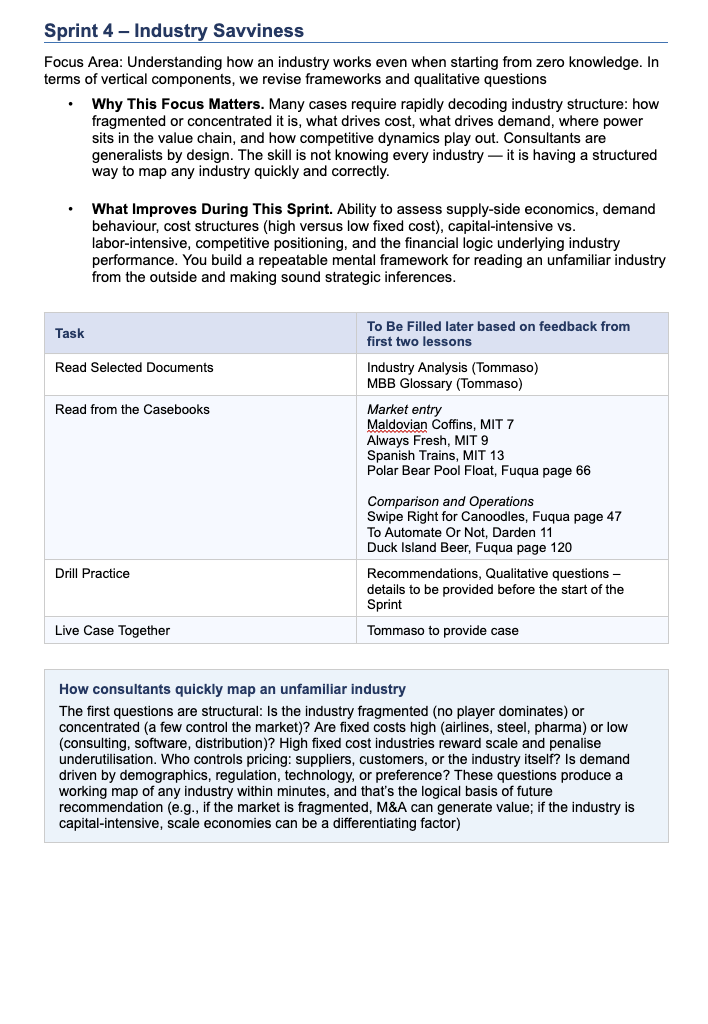
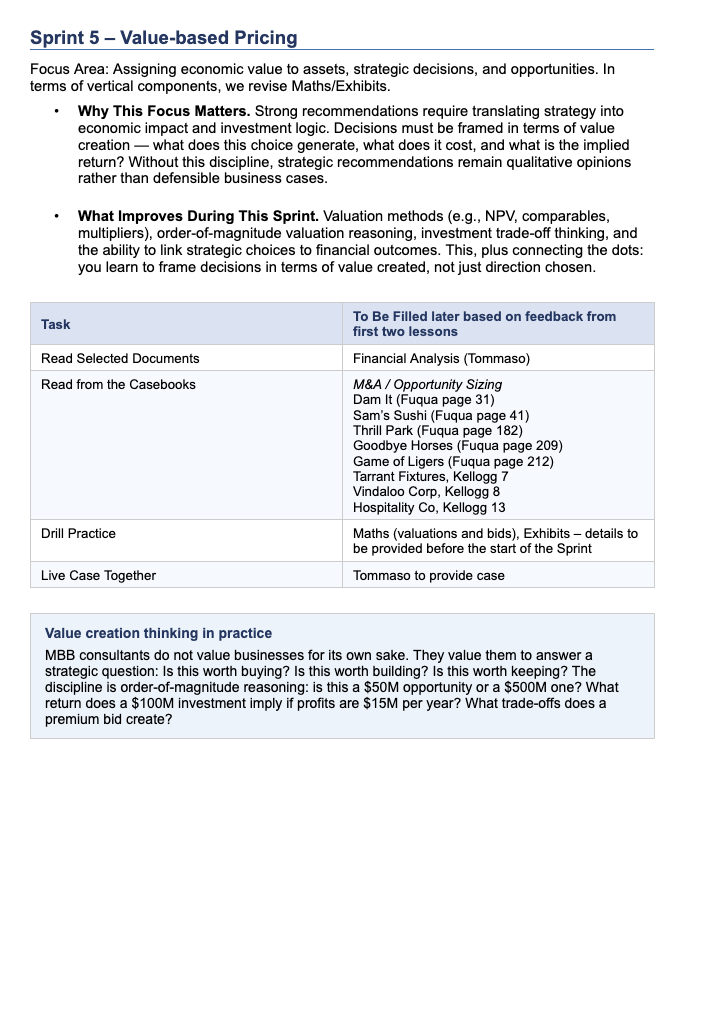
2. I organise the plan in Sprints (screenshot below). 

A Sprint is not just a lesson. It's a small learning cycle: it starts with a quick intro on the Sprint topic (e.g., Realistic Quantification) at the end of the previous session, then you get a curated set of at-home tasks — targeted theory documents, drills, and selected casebook cases on that topic — and the Sprint ends with our live session, where you put what you've learned into practice in a case with me. The idea is that you reach 6-7/10 on the topic through my intro, my documents, and highly focused self-study, and then I lift you up by a few points in the live session.

3. We follow this plan at roughly one lesson per week. 

Again, the live session is the focal, ending point of the Sprint: before that, I've already given you the intro and targeted your self-study. During the Sprint, I also encourage 2-3 live cases with peers, and I tell you exactly which cases to practice on.

My approach is not to study case type by case type. I focus on key "concepts" that have a more horizontal application — things like exhaustiveness, realistic quantification, profitability intuition, industry savviness, value-based pricing. Within these Sprints, I make sure we progressively cover all the case types, all the elements of a case (clarifying questions, structure, exhibits, maths, qualitative questions, recommendation), and all the main industries/functions.

At mid-point I do a new assessment, and at the end I do a final one. I am very transparent: I'll tell you directly if you need more sessions or if we've done enough. I also always allow clients to cancel at mid-course. Nobody has ever actually done it, but I want studying with me to be an active choice. Knowing you can walk away pushes you to keep asking yourself whether it's actually giving you value — and I've seen this is a great motivator.

My suggestion for you: 10 sessions is probably too much to start with. I'd do a few intro calls with different coaches and ask what they would recommend for your stage. The most important thing: choose a coach who builds an actual plan for you, not someone who just hands you 4-5 random cases without a holistic approach. Below is an example of what a structured plan can look like.

Hope this helps! Feel free (invite open to everyone) to DM me for a free intro call, with no obligation, or to book a 50%-off first session with discount code Tommaso50-Coaching-vbc

Best,
Tom

Profile picture of Soheil
Soheil
Coach
on May 17, 2026
INSEAD | EM & Strategy Consultant | 3.5Y Consulting | 5★ Case Coach | 350+ Cases | 50+ Live Interviews | MBB-Level

Hi there,

If a candidate came to me after about 10 cases, I’d usually see that as the ideal stage to start coaching.

At that point, people normally understand the basics of casing, but they haven’t yet built too many bad habits. That makes improvement much faster and more structured.

Personally, I wouldn’t use all 10 sessions the same way. I’d typically split the prep into phases.

Early sessions would focus on building strong foundations:

  • structuring
  • communication
  • math
  • recommendation/synthesis
  • learning how to think in a more interviewer-friendly way

Then later sessions would become more advanced and interview-like:

  • harder/unstructured cases
  • PEI/fit
  • pressure handling
  • interviewer-led cases
  • realistic mock interviews

What I’ve found is that the biggest value of coaching is usually not “doing more cases.” It’s having someone quickly identify:

  • what is actually holding you back
  • which weaknesses matter most
  • how to prioritize prep efficiently

A lot of candidates spend months practicing but improve slowly because they don’t have that feedback loop.

And honestly, if there’s no immediate deadline, that’s actually a very strong position to be in. It gives enough time to improve properly instead of rushing through prep.

Happy to chat if helpful, this is actually the exact stage where structured coaching tends to create the biggest jump in performance.


Best,

Soheil

Profile picture of Cristian
on May 19, 2026
Professional MBB coach | Success rates: 63% MBB only & 88% overall | ex-McKinsey consultant and faculty

That's an amazing question!

The first thing I'd do is try and understand their situation better, especially the target firms, geography and timeline that they have in mind. If they have some interview dates already, this creates natural limitations. 

Then I would run a baselining case with them, to understand where they are, what their strengths are and their areas of development. 

Once we do this, we can have a clear plan of how to close the gap to being ready at a distinctive level for the interview. 

We would decide together whether we can work with this timeline or whether we can change it e.g., move the interview. And also what is the intensity the candidate wants to work at and can work at e.g., number of hours per week of practice (which varies if you have a job or not in parallel). 

Typically, these are the first few steps. 

If you'd like us to have that discussion, feel free to reach out. 

Best,
Cristian

Profile picture of Mauro
Mauro
Coach
on May 19, 2026
Ex Bain AP | +200 interviews | 15years experience | Top MBB coach

Honestly, if someone already has ~10 cases and understands the basics, I would usually not structure the 10 sessions as “10 random mock interviews.”

I’d try to make the prep progressively more targeted.

Roughly speaking, I’d normally approach it in phases:

First sessions:

  • diagnose the candidate properly
  • identify the real bottlenecks
  • understand whether the issue is structure, communication, math, business judgment, confidence, fit, etc.

A lot of candidates think their problem is “frameworks” when actually it’s prioritization or communication.

Then I’d usually spend a few sessions on fundamentals:

  • structuring from first principles
  • communication under pressure
  • recommendation quality
  • driving the case proactively
  • brainstorming

Usually with drills + partial cases, not only full cases.

After that, I’d move to:

  • more realistic full interviews
  • harder / more ambiguous cases
  • partner-style discussions
  • pressure testing fit stories

And toward the end:

  • simulation mode
  • timing management
  • consistency across different case types
  • adapting style to different firms/interviewers

The other thing I think is very important is spacing the sessions properly.
If there is no rush, I actually think:

  • practice independently
  • peer casing
  • reflection between sessions

is where a lot of the learning happens.

The coaching session itself is often less important than what the candidate changes afterward.

And honestly, one underrated part of coaching is not just “improving casing,” but helping candidates understand:

  • what firms are actually evaluating
  • what level is truly interview-ready
  • how to position themselves
  • and sometimes even whether consulting is the right fit

Because many candidates have never seen a real consulting environment before.

So overall, I’d see coaching less as “doing cases together” and more as building a structured path from:
“someone who knows what a case is”
to
“someone who can consistently pass interviews.”

Profile picture of Alessa
Alessa
Coach
on May 17, 2026
20% off 1st session in July | Ex-McKinsey | Ex-BCG | Ex-Roland Berger

hi!

if someone has done around ten cases and wants ten coaching sessions, you build a journey, not ten disconnected drills. The goal is to make them consistent, calm, and structured before they ever apply.

Session flow usually looks like this: the first two sessions fix foundations,  structure, communication, and basic math habits. The next four to five sessions build range with different case types and pressure‑testing weak spots. The final sessions simulate real interviews, tighten synthesis, and polish the personal story. Between sessions, they follow a simple weekly plan with one or two peer cases, short daily drills, and targeted homework.

The idea is steady layering: fix one thing at a time, repeat it until it’s automatic, then move on. No rushing, no over‑casing, just clean habits built over weeks.

best, Alessa

Profile picture of Ashwin
Ashwin
Coach
on May 19, 2026
Ex-Bain | Help 500+ aspirants secure MBB offers | Highly rated case book on Amazon

Here's how I'd structure 10 sessions with no deadline pressure.

Session 1, Diagnostic. Run one full case. Spot weak areas. Set the plan.

Sessions 2 to 3, Structuring. Drill clean trees across different case types (profitability, market entry, growth, pricing, operations).

Sessions 4 to 5, Math and exhibits. Pure drills on percentages, ratios, sizing, and chart reading. Speed and accuracy.

Session 6, Full case integration. Put the pieces together.

Session 7, Synthesis. Practise sharp recommendations with conviction. Most candidates underprep this.

Session 8, PEI stories. Build 3 stories (Drive, Leadership, Courageous Change) with clear structure.

Session 9, Full mock interview. Realistic timing and follow-ups.

Session 10, Final calibration. One more case under interview conditions.

Between sessions, do 2 to 3 peer cases a week. Coaching gives precision, peers give volume.

Don't rush, 3 to 4 months is right. Drill weak skills in isolation before integrating. Record yourself and listen back weekly. Don't peak too early.

Good luck.

Profile picture of Vincent
Vincent
Coach
on May 18, 2026
Principal BCG | 60+ projects in all Industries | Munich & Zürich | Ex-Lazard & Berenberg

HI There,

10x sessions is sufficient to get you 70-80% of the journey. 

The sessions are structured like that: 

1 & 2) Diagnostic Call: Full MBB interview, scored as if you were sitting at MBB. Structured feedback along the dimensions used in the real interview

 3 & 4): Personal Storyline detailing: 

5 -7) Case 1:1 deep Dives along your weaknesses and different case types & industries

8) Interim Diagnostic Call: Full MBB interview along the same dimensions as in session 1 & 2

9-10) Refinement of open areas with dedicated Case sessions


Hope that helps, PN for more info :)

Vincent