Back to overview

Question: "Is there something we haven't asked you that we should?"

 I was asked this in an interview a few days ago and didn't know how to answer. the interview had been going well and they seemed to be actually out of questions. The senior interviewer then asked me "Is there anything you think we should ask you that we haven't already?"

I drew a blank and said no. I realized this was a great sales opportunity, but didn't know how to capitalize on it.

At this point they hadn't asked me the weakness question, or about strengths, or even any behavioural questions, all of which I was prepared for. 

What should I have replied?

10
300+
13
Be the first to answer!
Nobody has responded to this question yet.
Top answer
Profile picture of Soheil
Soheil
Coach
on Apr 20, 2026
INSEAD | EM & Strategy Consultant | 3.5Y Consulting | 5★ Case Coach | 350+ Cases | 50+ Live Interviews | MBB-Level

Hi,

I’ve had this question a few times, and I had the exact same reaction the first time — blank.

After a while, I realized they’re not really asking for “missing questions.” It’s more like:
“Is there anything important about you that we haven’t covered yet?”

So it’s basically a small window to strengthen your case.

Saying “no” is a missed opportunity.

What works well is to bring up one thing that would make you a stronger candidate, especially if it didn’t come up naturally.

In your situation (no behavioral questions asked), a very clean way to handle it would have been:

“Actually, we didn’t get into behavioral examples — maybe I can briefly share one that’s quite relevant. In my last role, I had to [situation], and what I learned there was [impact / takeaway].”

That’s enough. Short, focused, and relevant.

Another option is to reinforce a key strength:
“Something we didn’t touch on is my experience with X — in one project I did Y, which led to Z.”

Or, if there’s a potential gap in your profile, you can proactively address it:
“One thing I’d add is how I prepared for consulting despite not having direct experience — I’ve done X, Y, Z.”

The main idea is:
don’t try to say everything — just pick one point that strengthens your story and deliver it clearly in 30–60 seconds.

That’s it.

If you prepare 1–2 of these “backup points” in advance, you’ll never be stuck on this question again.


Best,

Soheil

Profile picture of Erica
Erica
Coach
on Apr 20, 2026
Ex-McKinsey EM | Life Sciences & AI | 50+ Interviews Conducted

This is basically a moment to make your closing pitch. It's unlikely this was meant as a "trip-up" at all; more than likely there was still time left in the interview or they were just genuinely curious if their process missed something important about you. At the same time, they might be checking for self-awareness, confidence, and whether you can advocate for yourself. 

A strong approach would have been something like the following:

"Actually, yes. You haven't asked me much about [specific relevant skill or experience], and I think that's one of the strongest things I'd bring to this role. For example, [brief compelling story]..."

"You know, we haven't talked much about how I handle [something relevant to the role, e.g., conflict, ambiguity, tight deadlines, cross-functional work]. I think it's worth mentioning because in my last role, I [brief story with a clear result]."

The good news is that now you'll be prepared if this ever comes up again! For the future, throughout any interview, mentally keep a short list of your two or three strongest selling points. If they've already come up naturally, great. If not, this question is your chance to deploy them. 

Profile picture of Alessa
Alessa
Coach
on Apr 21, 2026
10% off 1st session | Ex-McKinsey Consultant & Interviewer | PEI | MBB Prep | Ex-BCG

hey :)

this is actually one of the best hidden opportunities in an interview, so don’t worry that you missed it once. the intent behind that question is basically “sell yourself one more time in a structured way”.

the strongest way to answer is to proactively bring up something they didn’t cover yet and that strengthens your candidacy, especially your motivation and key strengths. for example you could say something along the lines of:

“I’m glad you asked. One thing we haven’t touched on yet is my motivation for consulting and why I’m particularly excited about this role. What really drives me is working on complex, high-impact problems and learning quickly in a steep environment. In previous experiences, I’ve seen that one of my core strengths is structuring ambiguous problems and staying very driven until I find a solution, even under pressure. That’s also why I’m especially interested in your firm, as I see a very strong fit with how I like to work.”

this way you do three things in one smooth answer: you show self-awareness, you bring in strengths, and you clearly communicate motivation. if something like weaknesses or a key story didn’t come up, you can also redirect to that instead.

happy to help you tailor a version to your profile if you want.

best,
Alessa :)

Profile picture of Franco
Franco
Coach
on Apr 20, 2026
Ex BCG Principal & Global Interviewer (10+ Years) | 100+ MBB Offers | 95% Success Rate

Hi,

I think that would have been your chance to highlight a strength and position yourself clearly in front of the interviewer.

Saying “no” won’t kill your chances if the rest went well, but it’s not the most elegant answer; you’re leaving value on the table.

A simple pivot works: “Actually yes, we didn’t touch on [X], which is one of my key strengths. In my last experience, I…”

Good luck,
Franco

Profile picture of Mauro
Mauro
Coach
on Apr 20, 2026
Ex Bain AP | +200 interviews | 15years experience | Top MBB coach

Good question — and you’re right, this is a bit of a “hidden opportunity.”

First thing: saying “no” is not a disaster. If the interview was going well, this won’t make or break it. That said, a better way to handle it is to use it to reinforce one key message about yourself.

You don’t need to be clever. Just pick something you want them to remember.

A simple approach is:
“Maybe one area we haven’t touched on is X, which I think is quite relevant for this role…”

Then give a short, structured example.

For instance:

  • a leadership example
  • a challenge / failure
  • a specific strength (e.g., ownership, problem solving)

Keep it short (1–2 minutes), not a full new story.

Another option, if you prefer to stay more subtle:
“Nothing specific comes to mind, but I’m happy to elaborate on any area you think would be helpful.”

Less impactful, but still solid.

What I’d avoid:

  • saying “no” and stopping there
  • trying to cover too many things
  • forcing something random

So in short:
treat it as a chance to highlight one thing you didn’t get to say, and keep it simple.

Profile picture of Ian
Ian
Coach
edited on Apr 21, 2026
Top US BCG / MBB Coach - 5,000 sessions |Tech, Platinion, Big 4 | 9/9 personal interviews passed | 95% candidate success

Hi there,

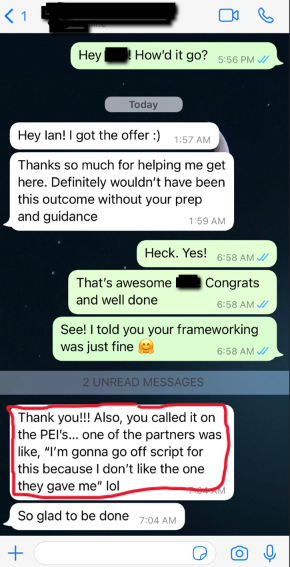
This is why I always prep my candidates to be ready for ANYTHING.

Train your ability to answer behavioral questions. Period. Not just the ones you've prepped for. Any behavioral question, including ones you've never seen before.

Train your ability to handle any case that comes your way. Period.

Don't "study" like it's a biology exam. You're not memorizing facts. You're building a way of thinking that adapts in real time.

On this specific question: it's a gift. Use it to surface a story or data point the interview didn't cover. Never say "no, I think we're good"  
(that's a missed opportunity)

Worth reading before your next prep session: How to Shift Your Mindset to Ace the Case

And if you want to train this live with someone who can throw anything at you: book a coaching session

Fingers crossed!

Profile picture of Kevin
Kevin
Coach
on Apr 22, 2026
Ex-Bain (London) | Private Equity & M&A | 12+ Yrs Experience | The Reflex Method | Free Intro Call

That's a tricky one, and it's completely understandable to draw a blank when you're put on the spot like that. It feels like a missed opportunity because it absolutely is a chance to sell yourself, but it's hard to recognize it in the moment.

The interviewer wasn't necessarily testing if they missed a standard question like strengths or weaknesses. They were giving you an open mic, a final opportunity to proactively demonstrate what you believe is most critical for them to know about you, or to reinforce a key strength. It’s a test of whether you can strategically frame your best attributes, even when not prompted.

Next time, think of it as your chance to highlight something unique or impactful that might not have fit neatly into their structured questions. You could say, "You know, we've covered a lot of ground today, but one thing I wanted to ensure I conveyed is my experience in [specific relevant skill or project], which I believe is particularly critical for tackling [a challenge common to consulting/the role] and aligns well with [firm value]." This allows you to bring in a powerful example or reinforce a key message without sounding like you're correcting their interview style.

Hope that helps you frame it better for next time!

Profile picture of Ashwin
Ashwin
Coach
on Apr 22, 2026
Ex-Bain | Help 500+ aspirants secure MBB offers

Yes it was a sales opportunity. Most candidates freeze here, so knowing what to do next time is valuable.

It is an open invitation to reinforce your fit and leave a strong impression. Two good ways to handle it.

Option 1. Share a story you did not get to tell. "One thing we did not cover is X, which I think is relevant because Y." Pick something that ties to the firm or role. Keep it under 90 seconds.

Option 2. Ask a sharp question that shows you are engaged. "Nothing from my side, but I would love to ask, what would someone joining this team in the first six months need to do to be seen as exceptional rather than just good?" This flips it into a mini conversation.

The worst answers are "No, you covered everything" or dumping your resume again. The best answers leave them with one sharp thing about you, or one sharp question from you.

In your case, since they had not asked about strengths or weaknesses, I would have said, "We did not talk about how I handle failure, and I think it is relevant because..." then a 60-second story with a clear lesson.

Good luck next time.

Profile picture of Tommaso
Tommaso
Coach
edited on Apr 20, 2026
Ex-McKinsey | MBA @ Berkeley Haas | Market Sizing Master | 50% off on 1st meeting in May (DM me for discount code!)

Hi Anonymous,

A 10/10 answer would be turning a perceived weakness into a strength. E.g., if you have a gap year early or if you needed an extra-semester to graduate, a few interviewers might not ask you directly but keep an internal bias ("What did she do in these months? Why did she need an extra semester"). If you can explain how you did something truly outstanding for your personal growth or your community, you'll truly impress interviewers!

Best,
Tom

Profile picture of Cristian
on Apr 24, 2026
Professional MBB coach | Published success rates: 63% MBB only & 88% overall | ex-McKinsey consultant and faculty

That's true. You could've sold yourself more. 

But it's also normal to draw a blank sometimes in interviews. 

For future situations, you might want to practice with a coach to explore these sorts of situations. This way, you'll be better prepared for a wild card question.

Best,
Cristian