


Back to overview

Pricing cases without competition

Hi!

I have one week to go for my McKinsey interview and there is one area I am still struggling with which is pricing cases. I just don´t understand how to actually approach them in a good way and I cannot find any examples online that help me understand them better. 

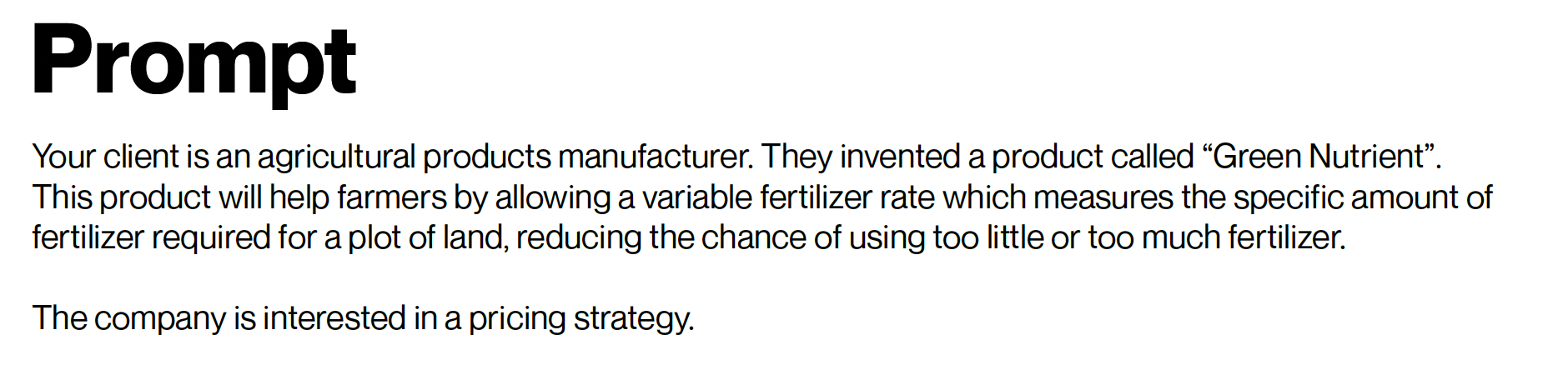
For example for the following case from the Ross Casebook: How would you approach setting a price. With price strategy they actually mean only what price should be set in this case and also important they are saying it is a new technology on the market with no competition. All you can find online are value to customers, competiton and costs but I don´t completely get that structure as it does not really help me determine the perfect price? isn´t it just weird to just have 2 buckets in this case with "what is it worth for customers (value)" and "what does it cost me?"
I think it should be simple but I cannot think of a decent solution for simple cases like this. 
Can you please help me and propose a structure on how to solve simple pricing cases like this one for a product?
 

1
< 100
0
Be the first to answer!
Nobody has responded to this question yet.
Profile picture of Federico
32 min ago
Ex-BCG Partner | 200+ Real Interviews | Case and Fit Coaching | Fully tailored approach

Hi! With no direct competition, value-based pricing is the standard approach. The two anchors you mentioned (cost and value to customer) are the right ones: cost is the floor below which you destroy value, value to customer is the ceiling above which they will not buy. The real question is where to price between them.

How to approach it:

  1. Quantify the floor. Cost to produce plus the minimum margin the client needs.
  2. Quantify the ceiling. Value created for the customer in their economics, measured against the next best alternative they have today. Even with no direct competitor, the customer is doing something now (existing fertilization practice, manual soil testing, older variable-rate systems) and that sets the reference point. For Green Nutrient, the ceiling is the fertilizer saved by avoiding over-application, plus any yield uplift from avoiding under-application, minus the cost of the current alternative.
  3. Pick a point in between based on strategic intent. Two ends of the spectrum: skim (price close to the ceiling to maximize margin per unit) or penetrate (price close to the floor to maximize adoption)
  4. If you want to push further, think about segmentation. Different customer groups have different willingness to pay and different use cases. You can launch tiered versions of the product, or price by usage, to capture value from each segment instead of leaving money on the table with a single price point.

Hope it helps. Feel free to drop me a message if anything is unclear and good luck with the interview!