Back to overview

MECE structures market entry/product launch ect

Hi everyone,

I’m currently struggling with structuring in case interviews, especially for questions like:
“Should we enter this market?”

A typical structure that seems logical to me is:

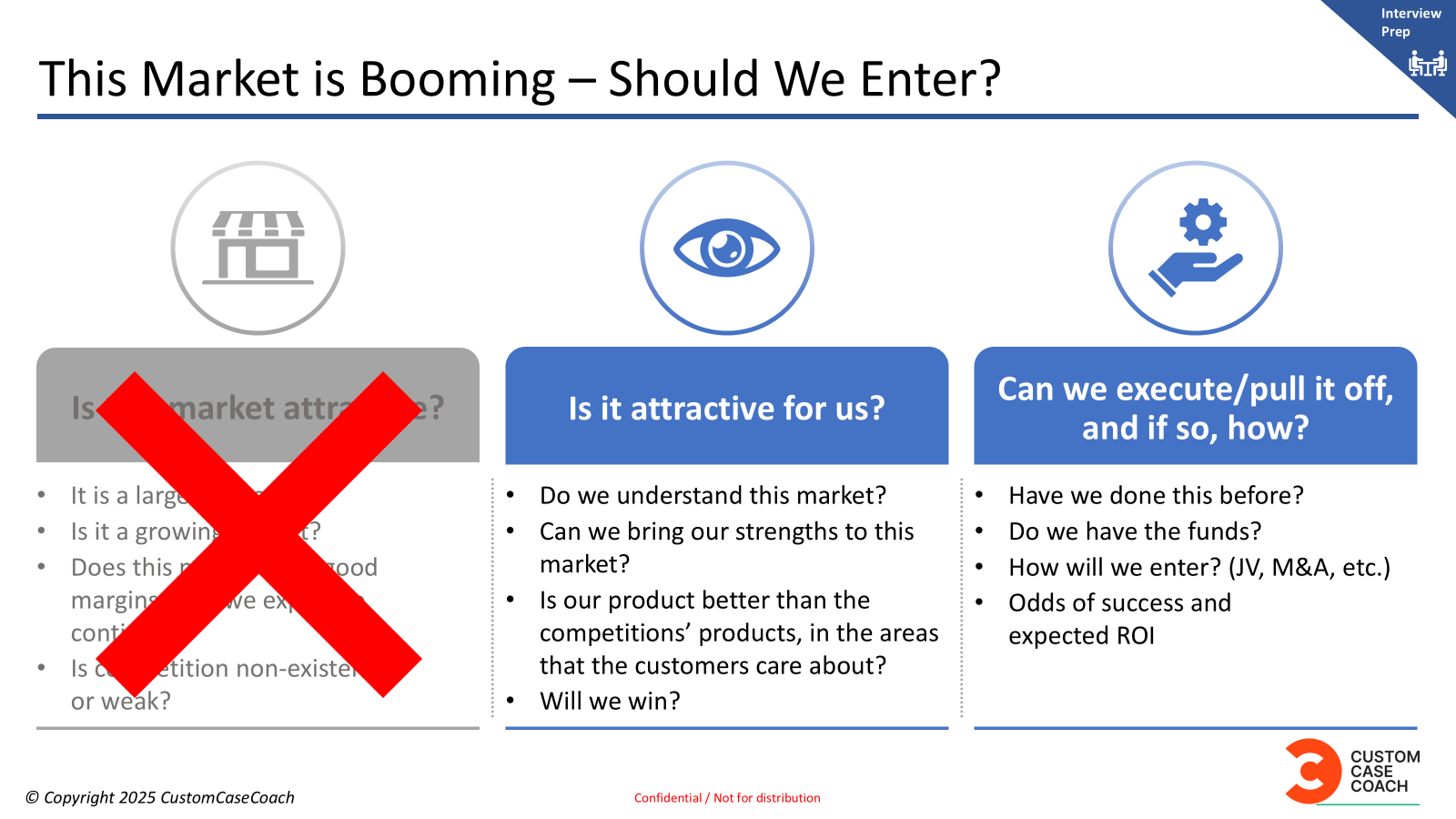
  1. Is the market attractive? (customers, demand, willingness to pay, growth, competitors)
  2. Do we have the capabilities/resources to compete?
  3. Is the opportunity financially viable / profitable?

However, I keep running into a conceptual issue with this structure.

When analyzing market attractiveness, I look at factors such as market size, growth, customer demand, and pricing dynamics to understand how attractive the market is overall. But at the same time, these exact outputs essentially determine the revenue potential of the business.

In other words:
The conclusions from the market analysis (e.g. how big the market is, how strong demand is, what price levels are realistic) directly shape the revenues that I later use in the financial analysis.

This is where I get stuck:
If the revenue potential is fundamentally derived from the market attractiveness, doesn’t that mean that the financials bucket is not really independent?

It feels like:

  • The market bucket already defines the “ceiling” of what is possible,
  • And the financials bucket is just a transformation of that into revenues and profit.

So my questions are:

  • How can this still be considered MECE if one bucket essentially determines the outcome of another?
  • Is MECE in case interviews about separating types of questions (e.g. attractiveness vs. profitability), rather than ensuring independence of results?
  • Or is there a better way to structure such cases to avoid this dependency?

I feel like I’m missing a fundamental principle here, because this issue comes up repeatedly across different case types.

Would really appreciate any guidance.

8
200+
8
Be the first to answer!
Nobody has responded to this question yet.
Top answer
Profile picture of Franco
Franco
Coach
on Mar 21, 2026
Ex BCG Principal & Global Interviewer (10+ Years) | 100+ MBB Offers | 95% Success Rate

Your structure is actually good, don't overthink it.

There are always multiple valid ways to structure a market entry case, but what you've proposed is logical and MECE. The key is how you think about MECE itself.

The buckets don't need to be independent, they just need to be mutually exclusive and collectively exhaustive. What you're describing (outputs of one bucket feeding the next) is not a flaw, it's just how structured thinking works in practice. You're essentially running a sequential process: three clearly separated phases where each builds on the previous. That's still MECE. It would only break down if the same question appeared in two buckets simultaneously which it doesn't in your structure.

So the apparent overlap you're sensing isn't a structural problem. Market attractiveness tells you what the opportunity looks like from the outside. The financial viability bucket then asks what it looks like for us specifically, factoring in our cost base, required investment, margin expectations, and payback period. Same inputs, very different questions.

One thing I'd add to make your framework even stronger: a dedicated risks bucket. Right now your structure answers "should we enter?" but doesn't explicitly pressure-test the downside. Adding risks would make it more robust and more consultant-like. For example: market risks, competitive risks, execution risks, opportunity cost risks.

With that addition, your framework covers attractiveness, capability, financials, and risks and it will look very solid in a room.

If you want to discuss further feel free to DM me!
Best,
Franco

Profile picture of Ian
Ian
Coach
edited on Mar 23, 2026
Top US BCG / MBB Coach - 5,000 sessions |Tech, Platinion, Big 4 | 9/9 personal interviews passed | 95% candidate success

Great - now you have a framework for ONE market entry question.

What if the prompt tells you they're already analyzed hte market and it's great?

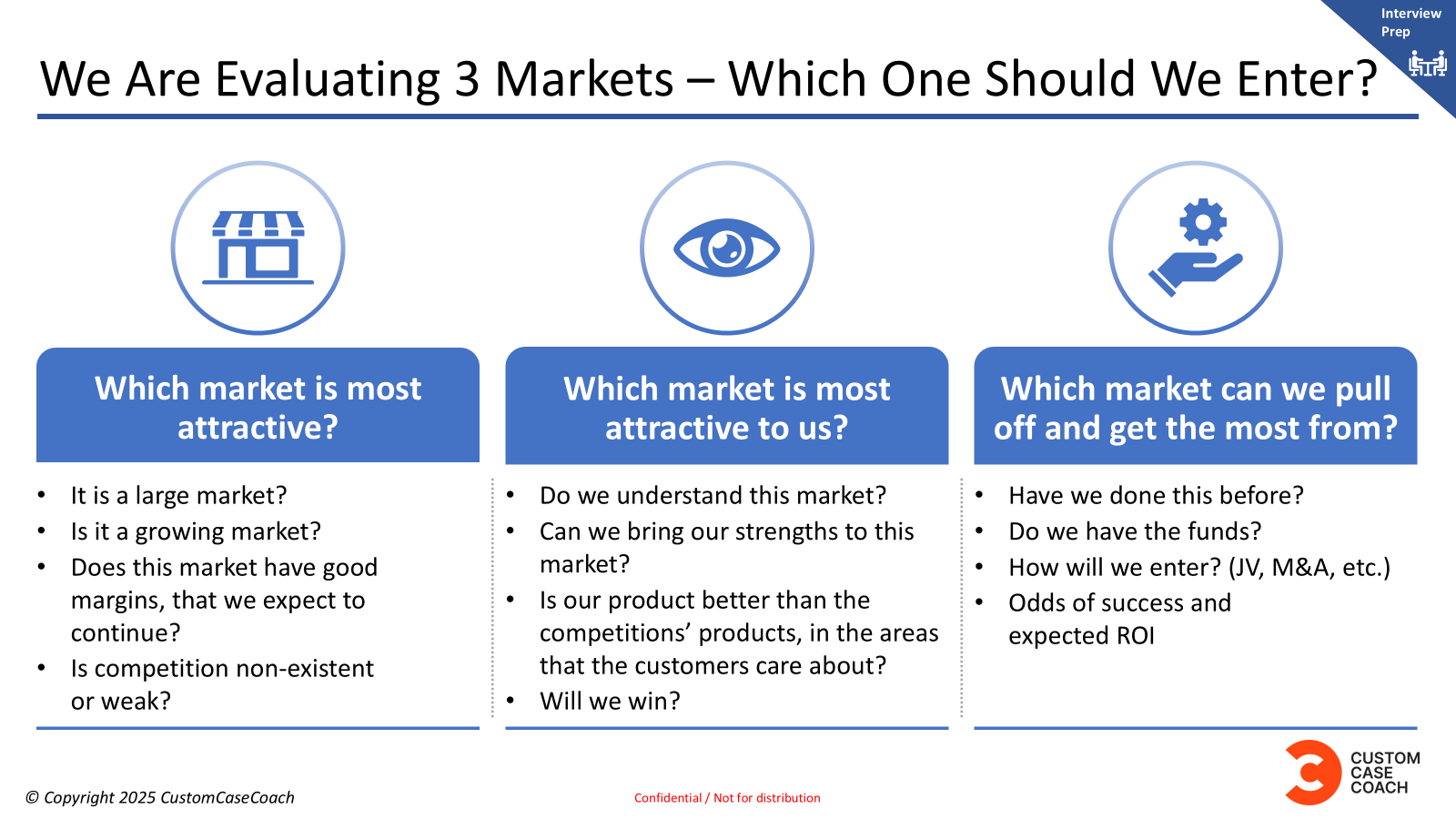
What if the prompt tells you they're evaluating 3 countries (markets)?

What if they're evaluating 3 customer demographics (markets)

What if they're evaluating 3 products (markets)

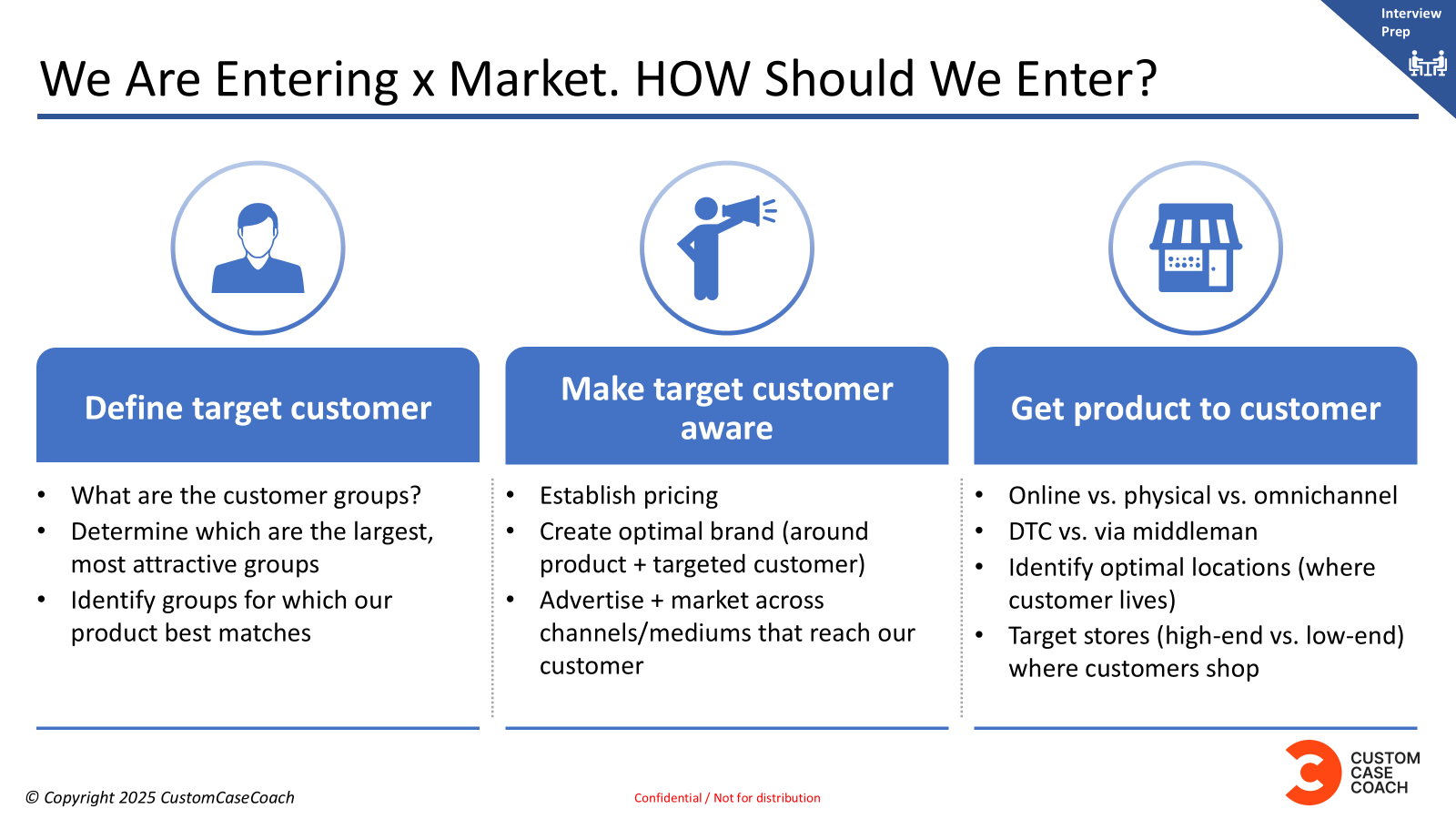
What if they need help entering the market and they want you to figure out how

What if they want help figuring out which distribution channel to launch through

What if they're deciding between running a pilot in the suburb versus the urban area?

What if 

What if

What if

You've addressed .01% possible case prompts

Because you're treating them as a mass produced thing. Stop now! (And ignore the other ChatGPT generated answers on this forum).

You need tailored frameworks for every case prompt. Period

Please grab my case interview (or frameworking course). You need a mindset shift here away from the generic online stuff

https://www.preplounge.com/en/blog/consulting/interview/how-to-shift-your-mindset-to-ace-the-case

End-to-end case interview training – from beginner to advanced

Profile picture of Kevin
Kevin
Coach
on Mar 22, 2026
Ex-Bain (London) | Private Equity & M&A | 12+ Yrs Experience | The Reflex Method | Free Intro Call

That's a really insightful question, and you've hit on a conceptual challenge many candidates grapple with. It's totally fair to feel like there's a dependency there, and you're not missing a fundamental principle as much as you're seeing the nuances of how MECE applies in a practical, problem-solving context.

The way to think about MECE in case interviews isn't about ensuring the results of your analysis in one bucket are entirely independent of another. Instead, it’s about ensuring your framework covers all critical areas without significant overlap in the types of questions you're asking. Your market attractiveness analysis absolutely helps define the revenue ceiling, but the "Financials" bucket isn't just a transformation of that. It's where you introduce the cost structure, the investment required, the pricing strategy (which may differ from market-derived price levels), and critically, assess overall profitability. You could have a massive, attractive market, but if the cost to serve it is too high, or the investment prohibitive, it's not financially viable.

So, while market size informs revenue, the financial bucket uniquely asks: "Given our capabilities and the market opportunity, what does this actually look like on a P&L and balance sheet? What's the ROI? What's the break-even point?" This ensures you're not just looking at the top-line potential, but the holistic picture of value creation. Your structure is sound because each bucket brings a distinct lens to the problem, even if information flows between them.

All the best!

Profile picture of Komal
Komal
Coach
edited on Mar 23, 2026
50% off 1st session. MBB Consultant. LBS MBA. 3+ years coaching experience. Practical coaching with in-depth feedback

Hi! In consulting, MECE is about structuring the questions, not forcing the answers to be independent

In a market entry case, “market attractiveness” and “financial viability” are logically linked, but they serve different purposes. The market lens defines the external opportunity (e.g. market size and growth), while the financial lens translates that into a company-specific outcome (what share we can capture, at what cost, and whether we make money). 

A cleaner way to think about it is: (1) Is the market worth entering in general? (2) Can we win there? (3) Will it make money for us? That separation keeps your structure MECE at the question level, even if the analysis naturally builds on itself. Consider adding a risk bucket as that's a key part of analysing any new venture or changing anything from status quo.

Good luck and feel free to dm to discuss further. 

Profile picture of Ashwin
Ashwin
Coach
on Mar 23, 2026
Ex-Bain | Help 500+ aspirants secure MBB offers

You have spotted something real but you are over-indexing on it.

Perfect MECE independence rarely exists in business problems. Markets, financials, and capabilities are all connected. The goal is not zero overlap. It is no meaningful double counting and no critical gaps.

Here is the distinction that matters. Market attractiveness tells you what the opportunity looks like from the outside. Financials tells you what it means for your specific business, given your costs, investment needs, and margin profile. Two companies can look at the same market and reach completely different financial conclusions. So they are not the same bucket.

On MECE in case interviews: it is primarily about separating types of questions, not ensuring mathematical independence. You are organizing your thinking so nothing important gets missed. Some logical dependency between buckets is normal and expected.

A reframe that helps: think of your three buckets as three separate decisions a CEO would make:

  • Is the market worth entering
  • Can we actually compete
  • Does the math work for us specifically

Each is a distinct judgment call even if the inputs overlap.

Stop trying to make the buckets airtight. Make them useful. That is what interviewers are actually evaluating.

Profile picture of Evelina
Evelina
Coach
on Mar 24, 2026
Lead Coach for Revolut Problem Solving and Bar Raiser

Hi there,

This is actually a really good question, and it shows you’re thinking more deeply than most candidates.

The key point is that in case interviews, MECE is about separating the type of questions you’re answering, not making sure everything is completely independent. In real life, business drivers are always linked. Revenue comes from the market, costs depend on capabilities, and so on.

In your structure, the difference is this:

  • Market attractiveness looks at the external opportunity (size, growth, pricing, competition)
  • Financials look at what it means for us specifically (what share we can capture, at what cost, and what profit that leads to)

So yes, the market defines the ceiling, but financials answer a different question: given this market, can we actually make money? Two companies can enter the same market and end up with very different results.

A simple way to think about it is:

  • Is this a good market?
  • Can we win?
  • Is it worth it financially?

Happy to help you practice this if useful

Best
Evelina

Profile picture of Alessa
Alessa
Coach
on Mar 25, 2026
10% off 1st session | Ex-McKinsey Consultant & Interviewer | PEI | MBB Prep | Ex-BCG

hey there :)

super good question and you’re not missing anything fundamental, this is exactly where many people get confused. MECE in cases is about separating lenses, not outcomes, so it’s totally fine that your financials build on your market insights

think of it like this: “market attractiveness” is external and asks what’s possible in the market overall, while “financial viability” is internalized and asks what this specific client can capture and turn into profit given their costs and model. same inputs partly, but different question

the clean way to make it feel more MECE is to slightly reframe: market and competition on one side, and then your client’s ability to win and monetize on the other. financials then become a synthesis, not just repetition, because you combine market size with your realistic share and your specific cost structure

so overlap in inputs is completely fine, what matters is that each bucket answers a distinct decision question

if you want, I can show you a super clean version you can reuse in interviews :)

best,
Alessa :)

Profile picture of Cristian
on Mar 23, 2026
Professional MBB coach | Published success rates: 63% MBB only & 88% overall | ex-McKinsey consultant and faculty

That structure is not bad and actually a decent starting point. 

But I'm reluctant to say that this structure is effective with other market entry cases. In fact, converging towards a magical structure that is like a key which opens all doors is probably the most common mistake that all candidates make. 

The most important thing about structuring (aside from relevance) is tailoring. 

If you need help on this, reach out and I can walk you in more detail through it.

Best,
Cristian