
Back to overview

McKinsey "What reasons ..." questions

Hi!

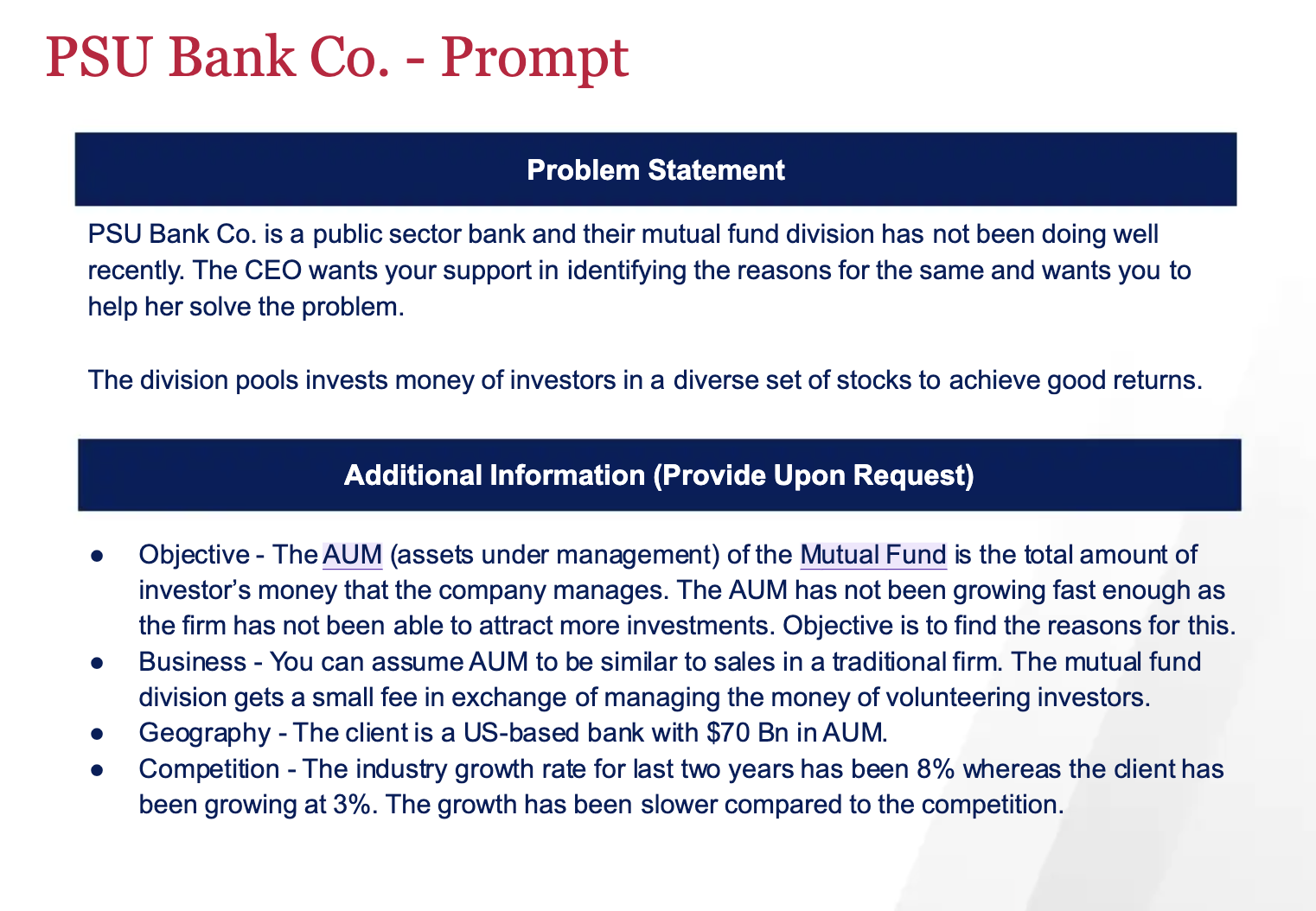
I have a question regarding the typical "What reasons ...?" Question at McKinsey interviews. For example in the picture below, I am always confused on what exactly they mean by "reasons", is it for example rather "less customers, lower income per customer" or more like the reasons behind these aspects like "are we targeting a different customer segment then our competitors and the one they are targeting is growing much faster? Do we have good products? Is our pricing competitive? Marketing ect?

It would be great if you could help me understand what they really want to here with such questions. For example for the case below the exact question is: What could be potential reasons for why the AUM has not been growing as fast as the competitors?

Thank you!
5
5
100+
Be the first to answer!
Nobody has responded to this question yet.
Top answer
Profile picture of Federico
on Jul 07, 2026
Ex-BCG Partner | Interviewer and Career Advisor | Fully tailored approach

Hi there,

Both of your interpretations are right, they just sit at two different levels, and the trick is to move through them in order rather than pick one. Think of it as the pyramid principle: start at the top and break down. This is how all MBBs expect you to think, by the way, not just McKinsey.

Level one is the mechanical breakdown of the metric. For AUM growth, that is roughly: are we attracting fewer new investors, losing existing ones, or is the money per investor lower. This does not yet answer "what reasons", it just locates where the gap is.

Level two is the actual reasons underneath each branch. Once you know where the gap is, you ask why: are we targeting a different customer segment than competitors and that segment is growing slower, are our products weaker, is our pricing (the fee) uncompetitive, is distribution or marketing the issue. This is where "reasons" really lives.

So when the interviewer asks "what reasons", they want you to structure it top-down: break the metric first to locate the problem, then reason into the drivers under the branch that matters. A candidate who jumps straight to a list of causes looks unstructured, and one who stops at the mechanical split has not answered the question.

Hope it helps. Feel free to drop me a message if anything is unclear and good luck with the prep!

Profile picture of Mauro
Mauro
Coach
on Jul 07, 2026
Ex Bain AP | +200 interviews | 15years experience | Top MBB coach

This is a great question, and the answer is: it depends on the context.

There isn't a mechanical rule that says interviewers always want one level of detail or another.

When McKinsey asks, "What could be the reasons...?", they're usually testing whether you can structure the problem at the appropriate level before diving deeper.

In your example (AUM growing slower than competitors), I'd probably start with the first level of drivers, for example:

  • fewer new clients
  • lower net inflows from existing clients
  • higher client attrition
  • weaker market performance (if relevant)

Then, for each of those, I'd naturally drill down into the underlying causes:

  • Are we targeting the wrong customer segments?
  • Is our value proposition weaker?
  • Are competitors offering more attractive products?
  • Is pricing an issue?
  • Are relationship managers less effective?
  • Is marketing weaker?

In other words, I wouldn't jump straight to "marketing" or "pricing" without first explaining which part of the business they affect.

A good rule of thumb is: answer at one level, then be ready to go one level deeper if the interviewer asks.

In my experience, McKinsey interviewers are often less interested in whether you guessed the "right" reason than in whether you can decompose the problem logically and move from high-level drivers to actionable root causes. That's the skill they're really assessing.

Anonymous A
on Jul 07, 2026
Okay thank you! But I am a bit confused on how this is MECE bc the drivers under the different high level buckets could sometimes be the same?
Profile picture of Alessa
Alessa
Coach
on Jul 07, 2026
20% off 1st session in July | Ex-McKinsey | Ex-BCG | Ex-Roland Berger

hey!

When McKinsey asks for “reasons,” they mean the simple, direct drivers of the outcome, not deep hypotheses. Think of it as the first layer: fewer new clients, clients leaving, lower inflows, higher outflows, weaker performance, pricing issues, product mix, distribution gaps. They are not asking for the underlying strategic explanations yet. They want the clean, top‑level drivers that explain the slower AUM growth. Once you list those, the interviewer may then ask you to explore why those drivers happen, and that’s where you go deeper into segments, products, pricing, marketing, competition, and so on. The trick is to start with the obvious direct drivers and only then move into the underlying causes if they ask.

Alessa

Anonymous A
on Jul 07, 2026
Okay so for example if the question is: What could be reasons that the lion population is decreasing? I should say for example: birth rate low, deaths increasing, migration and not for example human-induced reasons, natural reasons or something like human induced reasons, environmental reasons ect? Or if the question is: What factors do you want to analyze to decide why memberships in the gym are decreasing? Do I say bc more members are leaving or we get less new members or do I say for example external reasons, internal reasons?
Profile picture of Ashwin
Ashwin
Coach
on Jul 08, 2026
Ex-Bain | Help 500+ aspirants secure MBB offers

This trips up a lot of people. The answer: they want both, but in order. Start with the math, then the real-world reasons behind it.

First lay out the skeleton, because that keeps you MECE. AUM growth is basically net new money (inflows minus outflows) plus market performance on existing assets. That's your top layer, clean and complete.

Then go one level deeper into exactly the stuff you listed. Why are inflows weak? Wrong customer segment, weaker products, uncompetitive pricing, poor marketing. Why are outflows high? Bad performance, poor service, clients leaving.

So your two instincts aren't competing, they're two layers of the same answer. The breakdown shows structure, the reasons show judgment.

Just don't jump straight to "maybe our marketing is weak," or you'll miss whole branches. Say: "Let me break AUM growth into its parts, then dig into the drivers." Skeleton first, then the reasons.

Profile picture of Hagen
Hagen
Coach
on Jul 12, 2026
Globally top-ranked MBB coach | >95% success rate | 9+ years consulting, interviewing and coaching experience

Hi there,

I would be happy to share my thoughts on your question:

  • First of all, they actually want both layers, but in the right order, so for "why is our AUM growing slower than competitors" you start with the mechanical drivers, and only then you communicate the deeper reasons.
  • Moreover, one mistake is to jump straight to random root causes, so I would advise you to lead with three or four clean areas first, and then go one level deeper with concrete reasons inside each area, which is exactly the broad first, then deep logic McKinsey is looking for.
  • Lastly, I would strongly advise you to consider working with an experienced coach like me on your structuring skills. I developed the "Case Structuring Program" to help exactly such candidates like you who struggle with case study structures.

If you would like a more detailed discussion on how to best prepare for your upcoming McKinsey PEIs and case interviews, please don't hesitate to contact me directly.

Best,

Hagen