
Back to overview

Growth opportunities

Hi!

I have a question regarding a growth opportunities case. The prompt is the following: 

Your client is a global consumer packaged goods company —Grime Co.Grime Co. makes paper products (like paper towels), home cleaning products, and laundry care products. The company’s Board of Directors has set an aggressive revenue target of $2 billion four years from now. Currently, revenues are $1 billion. The CEO has come to you to ask for help. Specifically, our client would like you evaluate the company’s position and to help develop a strategy to deliver top-line results of $2 billion by 2025.

In my framework I had 3 buckets: market, current company performance and growth opportunities (through market growth, organic, unorganic). However, in the "solutions" the 3 buckets are only market growth, organic growth and anorganic growth. In this case, I am unsure if my framework would still be MECE since in the third bucket I am reliant on information I found in the first 2 buckets such as market growth, market share ect. Is this still fine?

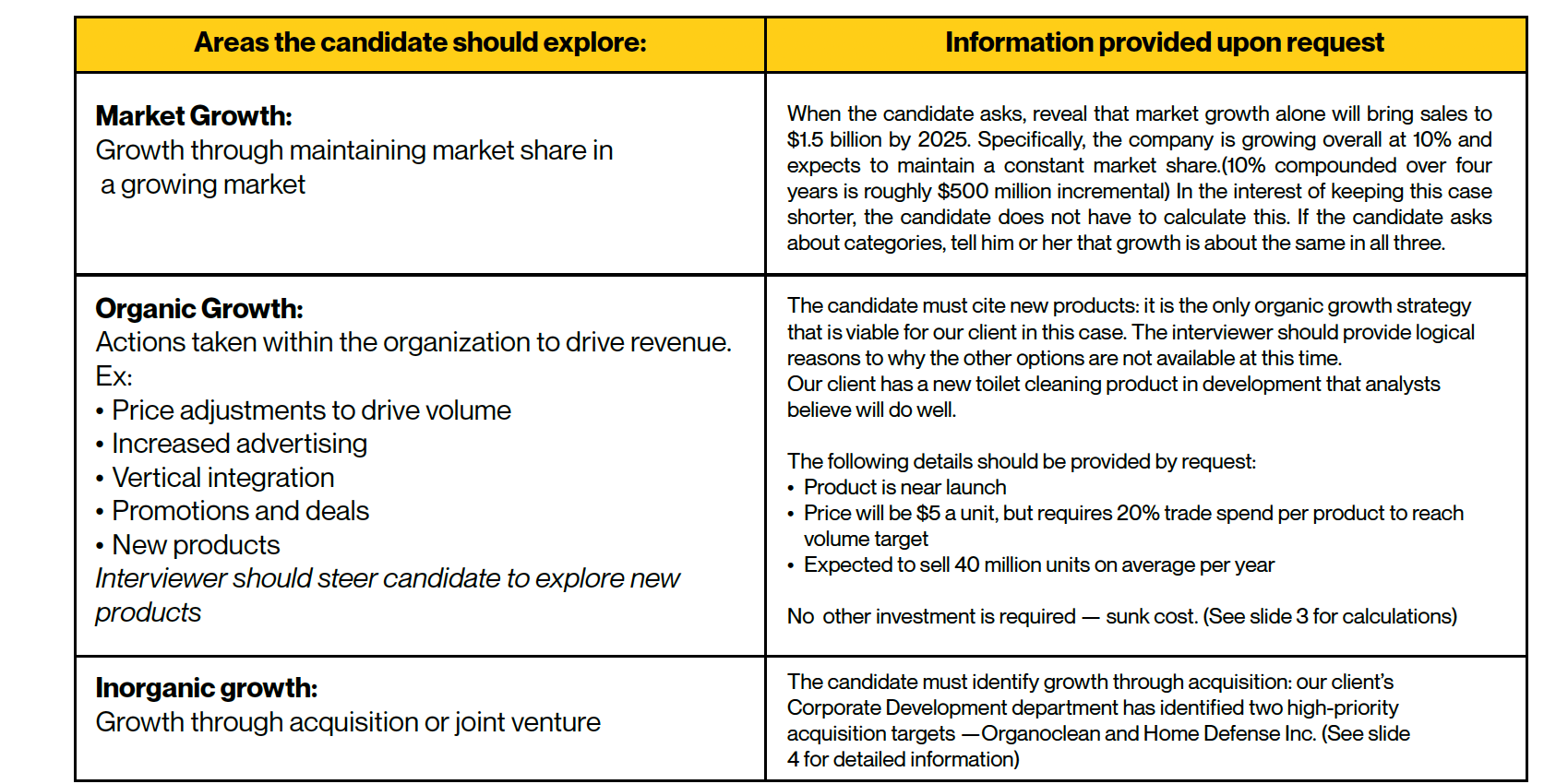
Here is the answer from the case book:

Thank you so much!
3
< 100
0
Be the first to answer!
Nobody has responded to this question yet.
Top answer
Profile picture of Franco
Franco
Coach
10 hrs ago
Ex BCG Principal & Global Interviewer (10+ Years) | 100+ MBB Offers | 95% Success Rate

Your framework is not very tight or directly linked to the key question, which is why it feels confusing

The issue is that buckets like “market” or “current performance” don’t clearly answer:  how do we get from $1B to $2B? They are more descriptive than actionable.

In these cases,  your buckets should map directly to revenue growth sources. That’s why the solution uses:

  • market growth (inertial growth)
  • organic growth
  • inorganic growth

That  structure is cleaner because it directly answers the question.

Also, “market growth” of the proposed solution alone is not enough;  you should clarify that you want to quantify how much growth will come naturally from the market, so you can isolate the gap that needs to be filled through organic and inorganic initiatives

In a nutshell you should make your buckets explicitly answer the growth question, not just describe the context

That’s what interviewers are looking for.

If you want to discuss further feel free to DM me
Best,
Franco

Profile picture of Cristian
11 hrs ago
Most awarded coach | Ex-McKinsey | Verifiable 88% offer rate (annual report) | First-principles cases + PEI storylining

Thanks for sharing this. 

The first impression that your structure makes on me is that it is overly traditional. It doesn't seem creative. It seems very much inspired by learned frameworks. 

Second, your structure consists of 'containers' in which you're planning on collecting information. But it's unclear how it all works together as a framework in order to answer the interviewer's questions. 

And all of this is without even reading the content closely, and even more importantly, hearing how they would deliver this in practice and engage with the interviewer. 

Doing excellently on structuring involves learning to structure from first principles, which is exactly what great consultants do as well. If you need help with this, drop me a line and I can explain how I work with my candidates on this. 

Best,
Cristian

Profile picture of Soh
Soh
Coach
edited on Apr 04, 2026
Lifesciences industry expert | Ex-ZS Interviewer | Global Commercial Strategy | M&A | 15m free intro | 10% off 1st case

Hi,

Thanks for your question.

To understand the difference between your framework and the one in the case solution, it may help to understand what the interviewer is looking for.

The objective of the framework is to guide you to solve the business problem at hand. When your framework is general, then you are telling the interviewer you are beating around the bush, instead of answering the question at hand. In your framework, you tried to create a hybrid model, where in the first two buckets you had generic buckets and the last one is more focused to the question at hand. This is a one-size fits all kind of framework vs. targeted to solve the case. Needless to say, the second approach is what they want to see.  Without knowing the prompt it is difficult to say if they have provided enough company information so you can proceed with the growth questions. If they have not, you can still create the targeted framework but then asking some questions on the company as relevant, before using your framework to guide the case.

You have a short amount of time to solve the case, just like in real world you have tight deadlines for projects. So the more tight you can make your framework, the more time you will have to focus on the right questions that need to be asked to solve it.

To summarize, don't try to boil the ocean with your framework but keep it targeted, which shows clear logical thinking instead of scattered thinking. 

Feel free to reach out if any questions.

Best,

Soh