


Back to overview

Growth opportunities

Hi!

I have a question regarding a growth opportunities case. The prompt is the following: 

Your client is a global consumer packaged goods company —Grime Co.Grime Co. makes paper products (like paper towels), home cleaning products, and laundry care products. The company’s Board of Directors has set an aggressive revenue target of $2 billion four years from now. Currently, revenues are $1 billion. The CEO has come to you to ask for help. Specifically, our client would like you evaluate the company’s position and to help develop a strategy to deliver top-line results of $2 billion by 2025.

In my framework I had 3 buckets: market, current company performance and growth opportunities (through market growth, organic, unorganic). However, in the "solutions" the 3 buckets are only market growth, organic growth and anorganic growth. In this case, I am unsure if my framework would still be MECE since in the third bucket I am reliant on information I found in the first 2 buckets such as market growth, market share ect. Is this still fine?

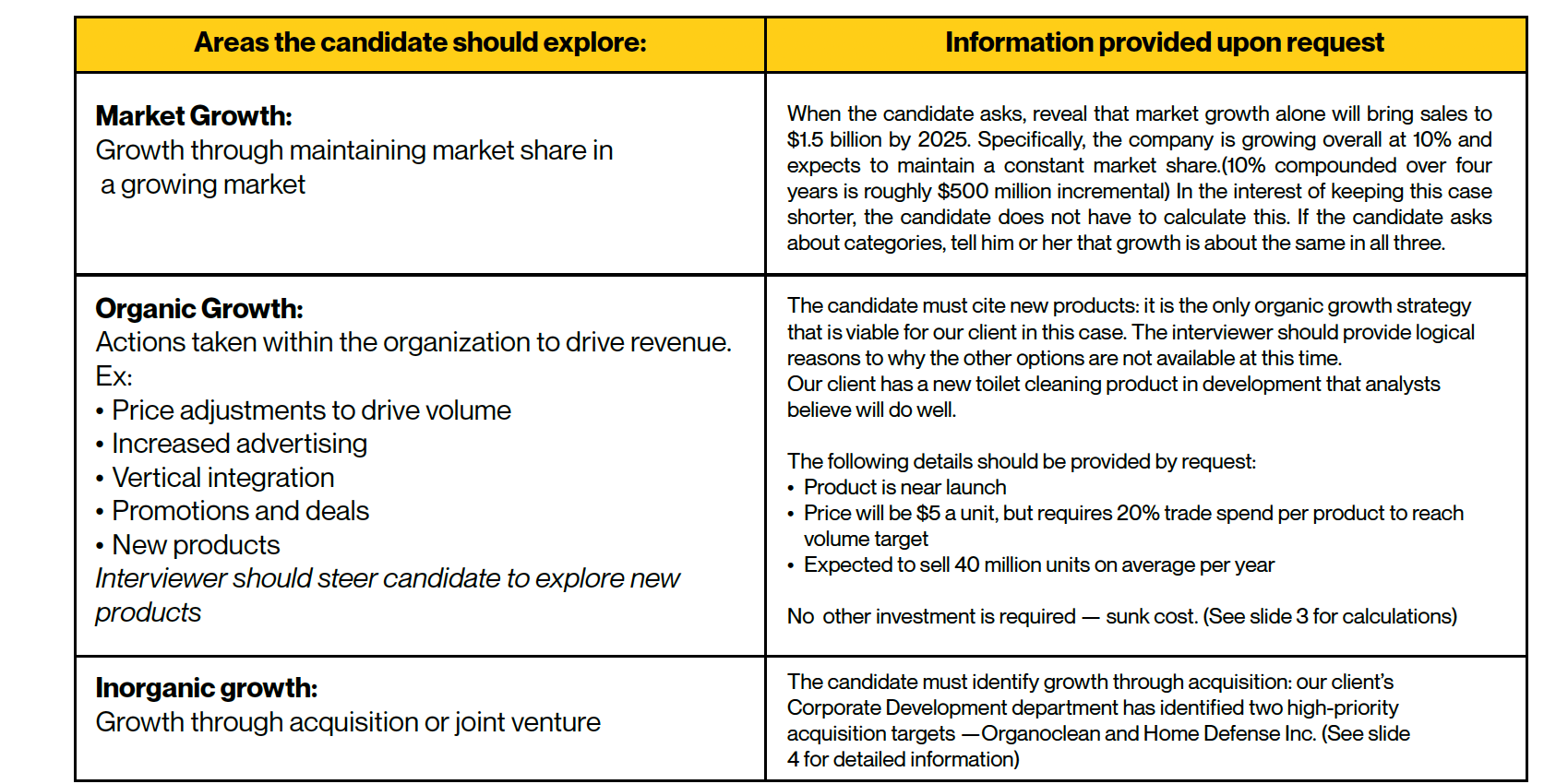
Here is the answer from the case book:

Thank you so much!
7
200+
11
Be the first to answer!
Nobody has responded to this question yet.
Top answer
Profile picture of Franco
Franco
Coach
on Apr 04, 2026
Ex BCG Principal & Global Interviewer (10+ Years) | 100+ MBB Offers | 95% Success Rate

Your framework is not very tight or directly linked to the key question, which is why it feels confusing

The issue is that buckets like “market” or “current performance” don’t clearly answer:  how do we get from $1B to $2B? They are more descriptive than actionable.

In these cases,  your buckets should map directly to revenue growth sources. That’s why the solution uses:

  • market growth (inertial growth)
  • organic growth
  • inorganic growth

That  structure is cleaner because it directly answers the question.

Also, “market growth” of the proposed solution alone is not enough;  you should clarify that you want to quantify how much growth will come naturally from the market, so you can isolate the gap that needs to be filled through organic and inorganic initiatives

In a nutshell you should make your buckets explicitly answer the growth question, not just describe the context

That’s what interviewers are looking for.

If you want to discuss further feel free to DM me
Best,
Franco

Profile picture of Ian
Ian
Coach
edited on Apr 04, 2026
Top US BCG / MBB Coach - 5,000 sessions |Tech, Platinion, Big 4 | 9/9 personal interviews passed | 95% candidate success

Hi there,

First, please avoid casebook frameworks. They're almost all incorrect.

Ultimately, I think you need coaching. It takes editing and feedback to figure out where you're going wrong.

Also consider my case interview course (half of it is frameworking).

That said, the time problem usually isn't about speed. It's a structure size problem. Most candidates build frameworks that are too big. 4 buckets with 3 sub-points each... that's 12 things. Cut it to 3 buckets, 2 sub-points max per bucket. You'll be faster and cleaner.

Second, make sure you have sub buckets, not a laundry list of ideas.

Finally, signpost. Be structured in how you walk through and use top down communication.

Customization literally has nothing to do with "elaboration". You're thinking customization leads to length. It doesn't.

Customization sows in your bucket labels, and HOW you communicate — not in how many sub-points you list. If your bucket labels could apply to any profitability case, they're too generic. "Revenue" and "Costs" tells the interviewer nothing about how you've thought about this specific problem. But "New market revenue shortfall" and "Fixed cost structure vs. declining volume" shows you've already started thinking. That's where the customization comes through... in the labels, not the elaboration.

Quick test: read your bucket labels back to yourself and ask "could I use these exact same labels on a different case?" If yes, they need to be more specific to this prompt.

Then, once your structure is on paper: be as precise and concise as possible while still covering all the critical bases. The depth comes out as you drive the case... not in the setup.

Worth reading on the mindset shift behind this: How to Shift Your Mindset to Ace the Case.

But again, you need coaching. This mindset shift is hard to get via a generic online forum: book a session here.

Good luck!

Profile picture of Soh
Soh
Coach
edited on Apr 04, 2026
Lifesciences industry expert | Ex-ZS Interviewer | Global Commercial Strategy | M&A | 15m free intro | 10% off 1st case

Hi,

Thanks for your question.

To understand the difference between your framework and the one in the case solution, it may help to understand what the interviewer is looking for.

The objective of the framework is to guide you to solve the business problem at hand. When your framework is general, then you are telling the interviewer you are beating around the bush, instead of answering the question at hand. In your framework, you tried to create a hybrid model, where in the first two buckets you had generic buckets and the last one is more focused to the question at hand. This is a one-size fits all kind of framework vs. targeted to solve the case. Needless to say, the second approach is what they want to see.  Without knowing the prompt it is difficult to say if they have provided enough company information so you can proceed with the growth questions. If they have not, you can still create the targeted framework but then asking some questions on the company as relevant, before using your framework to guide the case.

You have a short amount of time to solve the case, just like in real world you have tight deadlines for projects. So the more tight you can make your framework, the more time you will have to focus on the right questions that need to be asked to solve it.

To summarize, don't try to boil the ocean with your framework but keep it targeted, which shows clear logical thinking instead of scattered thinking. 

Feel free to reach out if any questions.

Best,

Soh

Profile picture of Cristian
on Apr 04, 2026
Professional MBB coach | Published success rates: 63% MBB only & 88% overall | ex-McKinsey consultant and faculty

Thanks for sharing this. 

The first impression that your structure makes on me is that it is overly traditional. It doesn't seem creative. It seems very much inspired by learned frameworks. 

Second, your structure consists of 'containers' in which you're planning on collecting information. But it's unclear how it all works together as a framework in order to answer the interviewer's questions. 

And all of this is without even reading the content closely, and even more importantly, hearing how they would deliver this in practice and engage with the interviewer. 

Doing excellently on structuring involves learning to structure from first principles, which is exactly what great consultants do as well. If you need help with this, drop me a line and I can explain how I work with my candidates on this. 

Best,
Cristian

Profile picture of Kevin
Kevin
Coach
on May 08, 2026
Ex-Bain (London) | Private Equity & M&A | 12+ Yrs Experience | The Reflex Method | Free Intro Call

That's a really common point of confusion, and you're spot-on to question the MECE aspect when you see a "solution" that looks different from your initial thought process.

Here's the reality: your framework is not only fine, but in many ways, it's more comprehensive in its initial setup. When you present a framework, you're laying out your plan to diagnose the problem and then solve it. Your "Market" and "Current Company Performance" buckets are crucial diagnostic steps. You simply cannot evaluate viable "Growth Opportunities" without first understanding the market landscape, Grime Co.'s current standing, and its historical performance. The case book's solution, "Market Growth, Organic Growth, Inorganic Growth," essentially jumps directly to the drivers of growth, often assuming that the foundational understanding of the market and company performance would be implicitly covered or discussed as part of the deeper dive into each growth driver.

So, don't sweat it. Your framework is perfectly logical for how you'd start to think about the problem. It provides a solid foundation before you dive into the specifics of how to grow. The key is to articulate the flow: "First, I'd want to understand the market and Grime Co.'s current position to identify where the best growth levers might be. Then, we can explore specific organic and inorganic opportunities." The "solution" is often a streamlined answer, not necessarily the ideal initial diagnostic structure.

Hope this helps clear it up!

Profile picture of Jenny
Jenny
Coach
edited on Apr 05, 2026
Ex-McKinsey Interviewer & Manager | +7 yrs Coaching | Go from good to great

Hi there,

It's fine to have a 3rd bucket that may include inputs from the prior buckets. This is seen in many cases. However, this approach is not always the BEST approach, depending on the case. This approach is particularly useful for diagnostic-heavy cases where the industry/sector is complex and requires high expertise, and you as a generalist comes in and must get a feel of the ropes quickly. In this case, this framework seems a bit "duh" as there could be sharper frameworks that would more directly help you answer the question (e.g. breaking down potential growth areas into organic - selling more of the same thing, selling more of adjacent things, selling more of completely new things and inorganic). 

Profile picture of Ashwin
Ashwin
Coach
on Apr 06, 2026
Ex-Bain | Help 500+ aspirants secure MBB offers

The casebook keeps the three buckets completely separate. Market growth is external. Organic is internal actions. Inorganic is acquisitions. Each one answers a different question and nothing overlaps.

Your framework had market in bucket one and again inside bucket three. That is the overlap that breaks MECE.

Your diagnostic thinking is not wrong. Just do it as a setup step before presenting the framework. Say: let me first understand the market and our current position, then I will look at three growth levers. That way the context informs the structure without creating overlap.