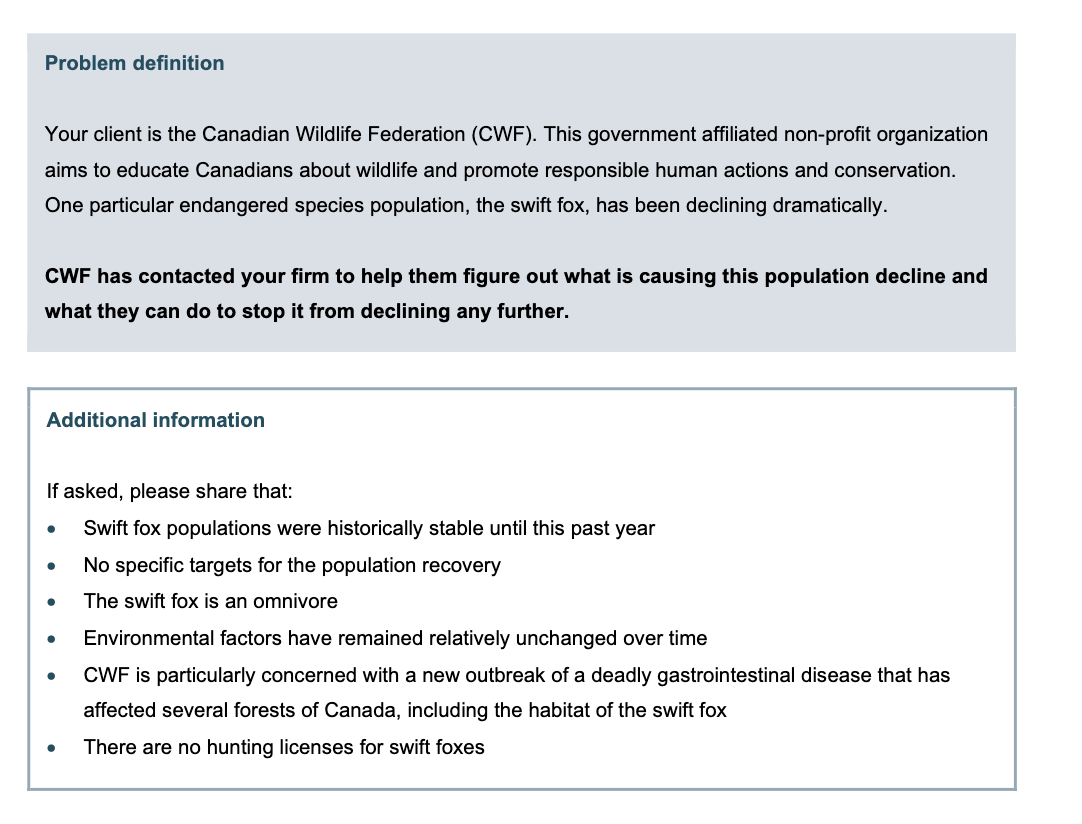
Hi! I have a question regarding the Canadian Wildlife Federation case from CaseCoach.
The interviewer asks: "What could be the reasons why the fox population is declining?" CaseCoach suggests structuring the answer into lower birth rates, higher death rates, and migration, arguing that this is the most MECE approach.
However, I don't fully understand why this is considered more MECE.
My concern is that many underlying drivers seem to affect multiple buckets at the same time. For example, habitat loss, climate change, or disease could simultaneously reduce birth rates, increase mortality, and trigger migration. The buckets therefore don't appear to be mutually exclusive at the level of the underlying causes.
My instinct would instead be to structure the problem based on the underlying drivers, for example:
- Human-induced factors (e.g. hunting, urbanization, pollution)
- Environmental and ecological factors (e.g. climate, predators, food availability, disease)
- Population-specific factors (e.g. age structure, genetics, fertility)
In the CaseCoach explanation, it is mentioned that a root-cause-based structure like this is less MECE, because it is more difficult to ensure that all possible reasons are covered and assigned to the right bucket.
This is the part I am struggling with. Am I missing something, or would a root-cause-based structure like mine also be considered a valid MECE approach? In a McKinsey interview, would my approach be acceptable, or is the births / deaths / migration framework generally the better way to structure this type of question?