

Our client is NordWerk Components, a privately owned Tier-2 automotive supplier headquartered in Germany. The company generates approximately €420m in annual revenue and employs around 2,000 people across three plants.
Over the last 18 months, NordWerk has been impacted by declining OEM call-offs, rising energy and raw material prices, and increasingly delayed customer payments. As a result, liquidity has deteriorated, and management fears a potential covenant breach within the next 6–9 months.
Management has asked you to support a restructuring program, starting with liquidity planning to stabilize the business and maintain stakeholder confidence.
Case Prompt:
Question 1
How would you structure a liquidity-focused restructuring approach? Please go beyond a simple sources-and-uses-of-cash framework.
1. Immediate horizon: today to 13 weeks – liquidity survival
- Focus: Cash visibility and control
- Key topics:
- Set up a rolling 13-week liquidity forecast
- Identify minimum liquidity threshold and covenant headroom
- Freeze discretionary cash outflows (capex, bonuses, non-essential spend)
- Stress-test downside scenarios (e.g. further revenue drop, delayed collections)
- Objective: Ensure the company does not run out of cash and avoids technical default
2. Short term: 3–6 months – cash stabilization
- Focus: Active cash release
- Key topics:
- Working capital measures (inventory reduction, DSO improvement)
- Operational adjustments with immediate cash impact (shift reductions, temporary shutdowns)
- Supplier and customer negotiations linked to liquidity planning
- Objective: Create liquidity headroom and buy time for deeper restructuring
3. Medium term: 6–18 months – structural cash generation
- Focus: Fixing the cash engine
- Key topics:
- Portfolio and customer profitability from a cash perspective
- Plant-level breakeven and fixed-cost absorption
- Footprint consolidation or carve-outs
- Objective: Restore sustainable cash generation, not just one-off relief
4. Strategic horizon: 18+ months – future-proofing
- Focus: Long-term resilience
- Key topics:
- Capital structure optimization
- Strategic repositioning of the business model
- Potential equity injections or M&A options
- Objective: Ensure the company is structurally viable beyond the crisis
Question 2
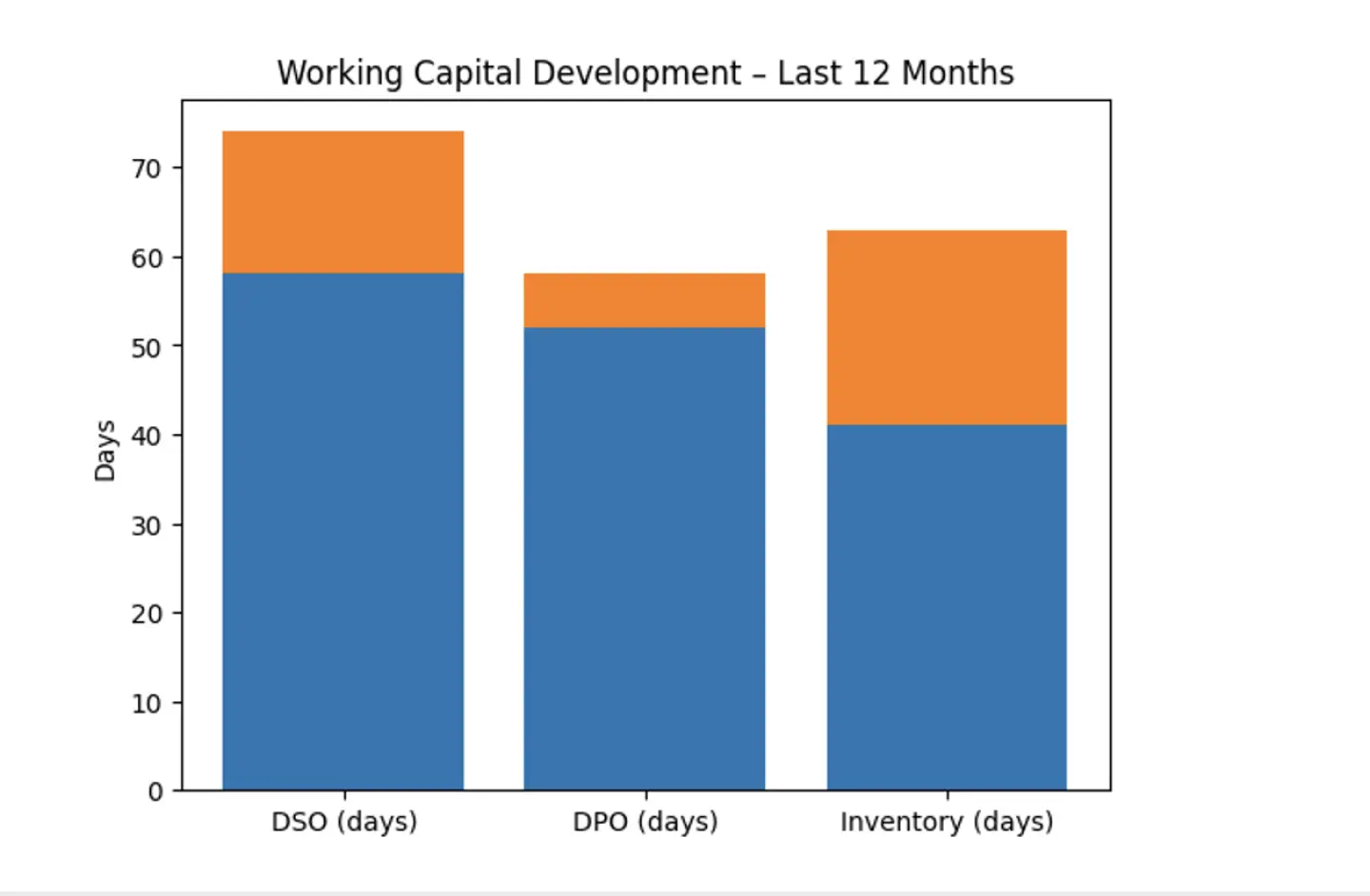
The client shares the following working-capital development over the last 12 months. What are your key insights from a liquidity planning perspective?
- Net working capital increased by €38m
- Revenue declined by 12% year-on-year
The chart shows a structural deterioration of cash conversion. Inventory days have increased significantly, indicating misalignment between production and demand. DSO has risen sharply, meaning the company is financing customers. DPO has increased only marginally, suggesting limited remaining supplier flexibility. Combined with declining revenue, these trends pose a severe liquidity risk.
Insight 1: Inventory is the dominant driver of liquidity deterioration.
- Data: Inventory days increased from 41 to 63 days over the last 12 months, a rise of more than 50%, while revenue declined by 12% in the same period.
- Explanation: This indicates that production and procurement have not been adjusted quickly enough to lower demand, leading to excess raw materials and work-in-progress tying up cash. The issue is structural rather than seasonal, as inventory is rising despite falling volumes.
- So what: Inventory is now the largest and fastest lever to release cash, but reducing it will require operational interventions such as production cuts or plant-level adjustments, not just financial controls.
Insight 2: Customer payment behavior is materially weakening liquidity.
- Data: DSO increased from 58 to 74 days, meaning customers take over two weeks longer to pay than a year ago.
- Explanation: NordWerk is effectively financing its customers for longer, likely due to weaker negotiating power with OEMs or operational issues such as disputes and delayed invoicing. This increase consumes significant cash every month.
- So what: Without active receivables management and escalation toward key customers, liquidity planning assumptions will be unreliable and short-term cash forecasts may prove overly optimistic.
Insight 3: Supplier financing potential is nearly exhausted.
- Data: DPO increased only modestly from 52 to 58 days, significantly less than the increases in DSO and inventory days.
- Explanation: Management has already stretched supplier payments, but the limited increase suggests further extension may not be feasible without damaging supplier relationships or supply continuity.
- So what: The company cannot rely on suppliers to fund the liquidity gap; additional measures must focus on internal cash release or external financing options.
Question 3
Assume monthly revenue of €35m, gross margin of 22%, a potential reduction of 10 DSO days and 15 inventory days. Can €25m liquidity be freed within 6 months?
Daily revenue is approximately €1.17m. A 10-day DSO reduction frees ~€11.7m. Daily COGS are roughly €0.91m, so a 15-day inventory reduction frees ~€13.7m. In total, ~€25.4m liquidity could theoretically be released, though execution risk is high.
Question 4
If liquidity deteriorates faster than expected, what additional short-term measures should management consider?
Options include temporary shutdowns or shift reductions, capex freezes, sale-and-leaseback transactions, covenant renegotiations, factoring, selective plant closures, and exiting cash-negative customers or products.
Questions 5
What would you recommend management do in the next 90 days?
Management should immediately implement rigorous 13-week liquidity planning, execute working capital measures to unlock short-term cash, and prepare contingency options such as asset-backed financing or footprint adjustments. This stabilizes liquidity while preserving strategic flexibility for a deeper restructuring.
NordWerk - Restructuring & Liquidity Planning
i