
Consulting Consulting
Back to overview

Comparison cases

Hello!

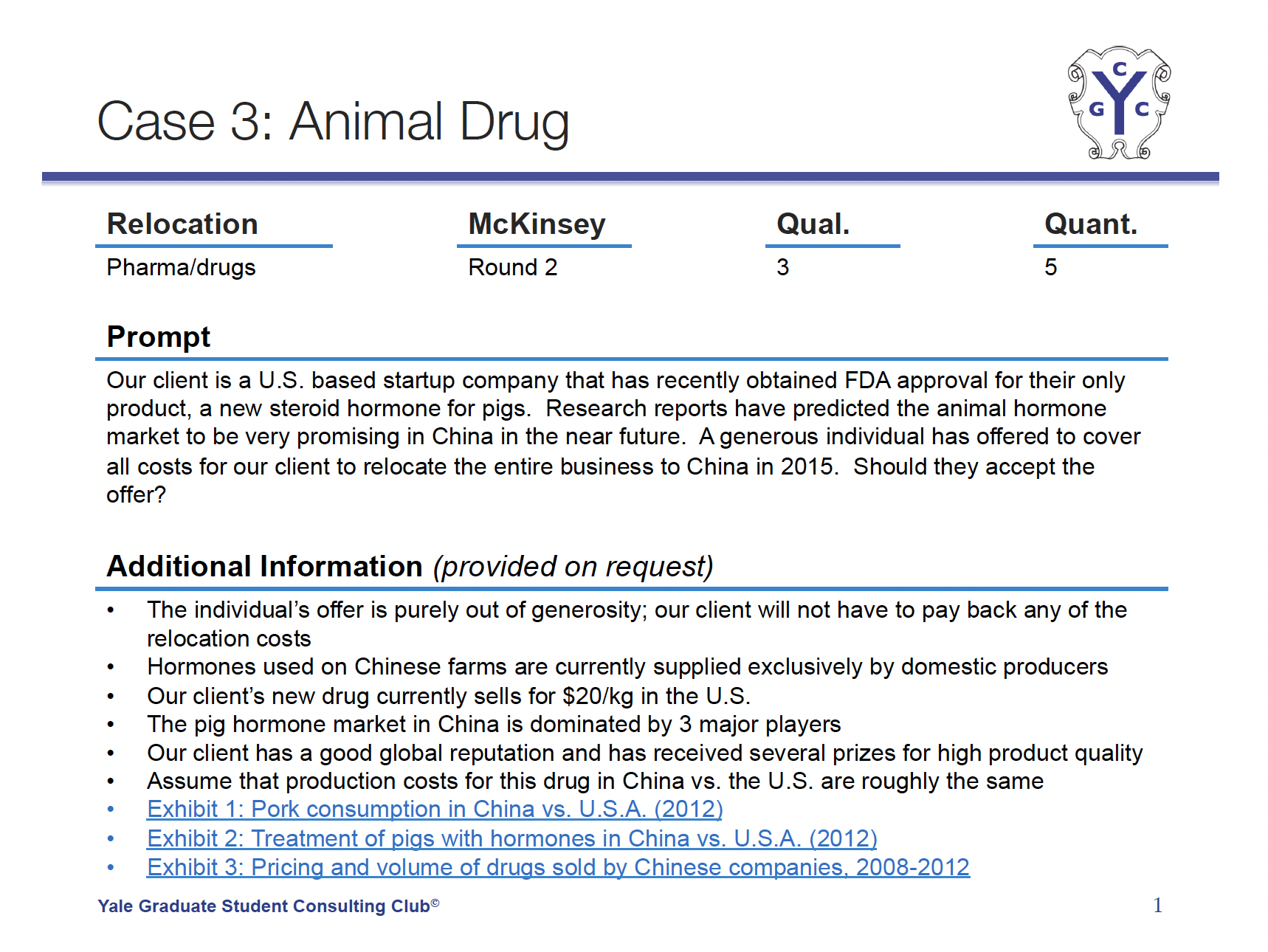
I have practiced quite a lot recently but one area where I just do not know how to approach it is if I need to compare 2 or 3 countries. I just do not know how to come up with a MECE Mckinsey style structure for such cases. An example of such a case is below. Could you please help me to understand how to come up with a structure in such cases? i am always super confused if I should have different buckets for the different countries or compare the 2 countries across diverse buckets ect.

Thank you!
14
5
200+
Be the first to answer!
Nobody has responded to this question yet.
Top answer
Profile picture of Tarek
Tarek
Coach
edited on Aug 01, 2026
UAE "WH" | Public Sector expert | Former RB PM | +100 interviews | Cambridge

The cleanest way to avoid overlap in a comparison case is to separate screening criteria from ranking criteria.

Screening criteria are pass/fail. For a relocation, these could include legal permission to operate, minimum supply reliability, IP protection, or a maximum acceptable implementation time. If an option fails one of these, it drops out regardless of how attractive the market is.

Ranking criteria are the trade-offs among the viable options. Choose three or four, define the metric once, and assign weights linked to the client's objective. For example:

  • five-year economic value: 50%;
  • strategic capability fit: 25%;
  • execution difficulty: 15%;
  • reversibility: 10%.

The important discipline is not the exact percentages. It is that each fact appears once: market growth affects the economic-value score; it should not receive a second score under “market attractiveness.” Define the scoring scale before looking at the result so you do not reverse-engineer the recommendation.

Finally, run a sensitivity test. If China wins only when economic value is weighted at 50% but loses at 40%, say the decision is fragile and identify the evidence needed to resolve it. That shows real comparison logic: screen first, rank second, then test whether the conclusion survives reasonable changes in priorities.

Profile picture of Franco
Franco
Coach
on Jun 16, 2026
Ex BCG Principal & Global Interviewer (10+ Years) | 100+ MBB Offers | 95% Success Rate

I would not think about this as a "country comparison" case first. At the end of the day, this is a comparison between two scenarios:

  1. The company stays in the U.S. (base case)
  2. The company relocates to China (alternative scenario)

Because of that, I would avoid creating separate country buckets in the structure. Instead, I would focus on evaluating the attractiveness of each scenario and then comparing them.

A simple top-down structure could be:

1. Financial impact

  • Revenue potential
  • Costs
  • Profitability

2. Strategic considerations

  • Market growth potential
  • Competitive dynamics
  • Access to customers
  • Brand and positioning

3. Risks and implementation

  • Regulatory risk
  • Execution risk
  • Political/geopolitical risk
  • Operational complexity

You would estimate the potential size of the Chinese market, derive expected revenues, estimate costs, calculate profits, and then compare those profits with the U.S. scenario.

Only after understanding the financial attractiveness would you layer in the non-financial considerations.

Hope this helps,
Best,
Franco

Anonymous A
on Jun 17, 2026
Hi!
But are those buckets MECE? Isn´t revenue potential and then again market growth potential and competitive dynamics the same aspect twice?
Profile picture of Alexander
on Jun 20, 2026
50% off on 1st meeting (DM me) | 5+ years of coaching & interviewing experience | Middle East & UK | BCG & Kearney

I would focus less on comparing countries and more on the decision the client is trying to make.

In this case, the question is not “How do the U.S. and China differ?” It’s “Should the client relocate to China?”

A simple structure could be:

  • Financial impact
  • Strategic attractiveness
  • Risks

Then compare the U.S. and China within each area.

One thing I often tell candidates: don’t get too focused on finding the perfect structure. Interviewers care far more about whether your approach is logical and easy to follow.

Keep it simple. Communicate clearly. Make it easy for the interviewer to follow your thinking.

Profile picture of Alessa
Alessa
Coach
on Jun 18, 2026
10% off 1st session in August | Ex-McKinsey | Ex-BCG | Ex-Roland Berger

You look at market size, hormone usage intensity, competition, pricing, and fit with the client. Then you evaluate China vs USA inside each of those. That’s exactly what the exhibits are built for. The picture just confirms that the right approach is one set of buckets and then compare both countries within them.

Alessa

Profile picture of Ashwin
Ashwin
Coach
on Jun 23, 2026
Ex-Bain | Help 500+ aspirants secure MBB offers

The trick with comparison cases is to compare across criteria, not within countries.

The wrong way. One bucket for Country A, one for Country B. Feels structured but isn't actually MECE, you just repeat the same analysis twice.

The right way. Pick 3 to 4 evaluation criteria as your top-level buckets, then compare countries within each.

Common criteria.

  • Market attractiveness (size, growth, demand).
  • Competitive landscape (players, intensity, share).
  • Operational feasibility (regulation, infrastructure, talent, costs).
  • Strategic fit (synergies with client's strengths, brand fit).

Then within each, compare A vs B directly. "On market attractiveness, A has bigger size but B has higher growth." That's a real comparison.

End with a clear recommendation based on weighted criteria.

Good luck.